
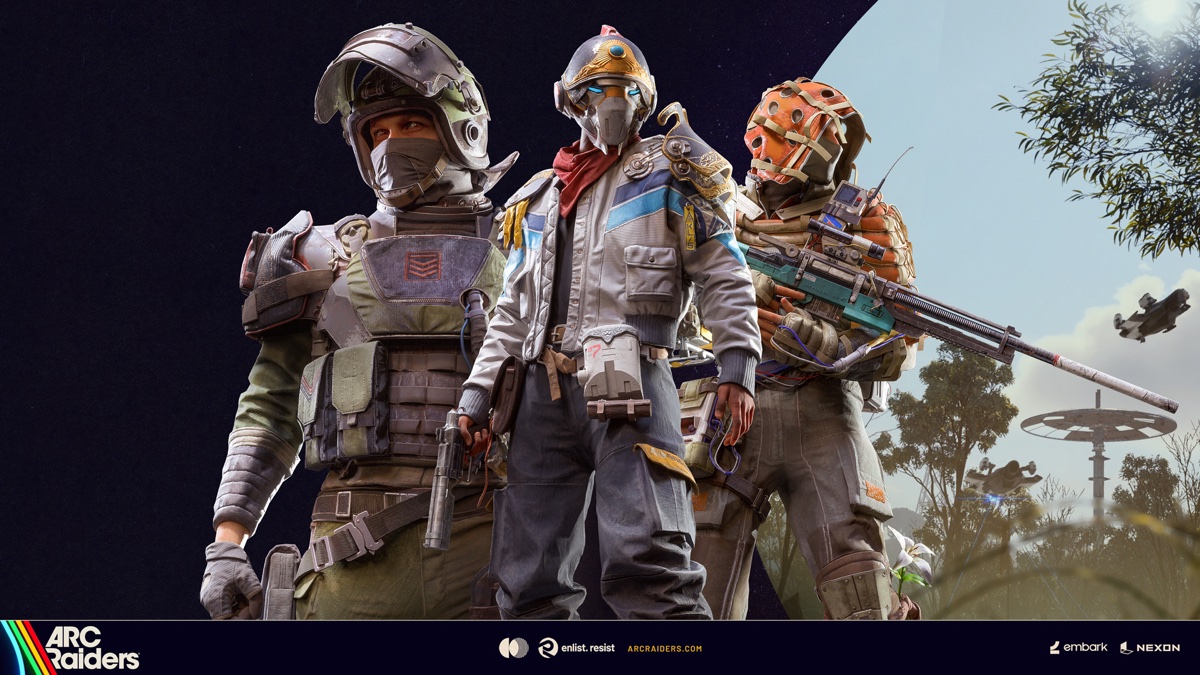
ARC Raiders Flashpoint Patch 1.22.0: What Changed, What's Good, and What Has the Community Divided
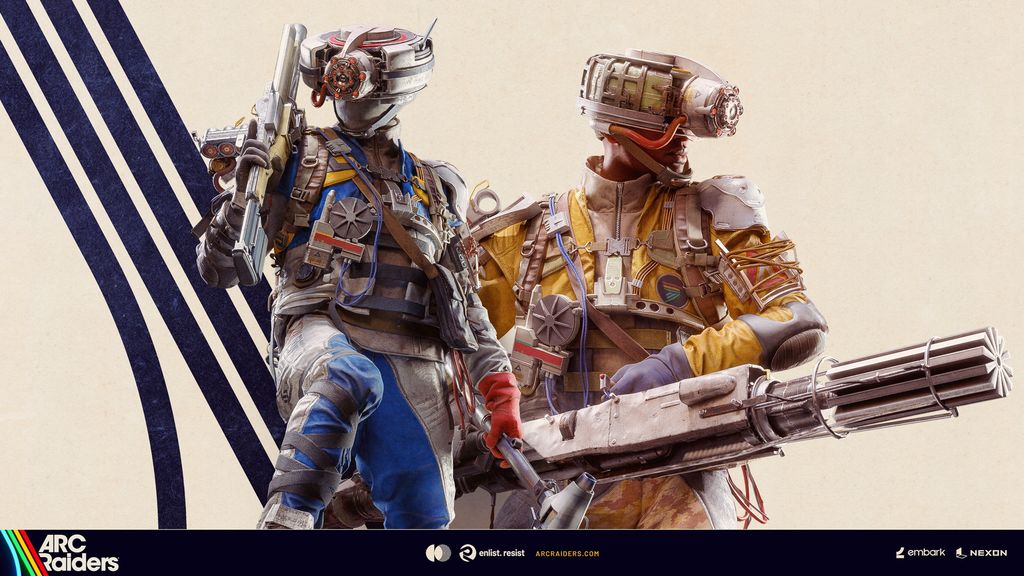
Patch 1.22.0 is live. ARC Raiders' Flashpoint update shipped today across PC, PlayStation 5, and Xbox Series X|S, bringing the new Close Scrutiny ARC Operation, the Vaporizer flying enemy, two weapons, a Scrappy feeding overhaul, and a matchmaking change the community has wanted for months.
The update arrives after a five-week gap since Shrouded Sky — long enough for the player count to settle around 115,000–118,000 daily Steam peaks, down from an all-time high of 481,966 in November. The question isn't whether the new content is good (early signs say yes). It's whether Embark's update cadence can hold a live-service audience that's already shown it will leave during droughts.
The Headline Features: Close Scrutiny and the Vaporizer
The biggest structural addition in Flashpoint isn't a new gun — it's ARC Operations, an entirely new category of map condition that fundamentally changes how a raid session plays out.
The first ARC Operation, Close Scrutiny, flips the extraction economy on its head. When it activates, loot availability across the entire map drops significantly. The valuable gear — the stuff worth dying for — gets concentrated inside the ARC Assessor, a massive unarmed machine that makes controlled landings throughout the zone. The Assessor itself won't shoot back. Everything swarming around it absolutely will.
This is smart design. Rather than just adding more stuff to find, Close Scrutiny creates a gravitational pull that forces raiders toward the same high-risk point of interest. It's a PvPvE pressure cooker — you're fighting ARC threats to crack the Assessor open while knowing every other squad on the map has the same idea.
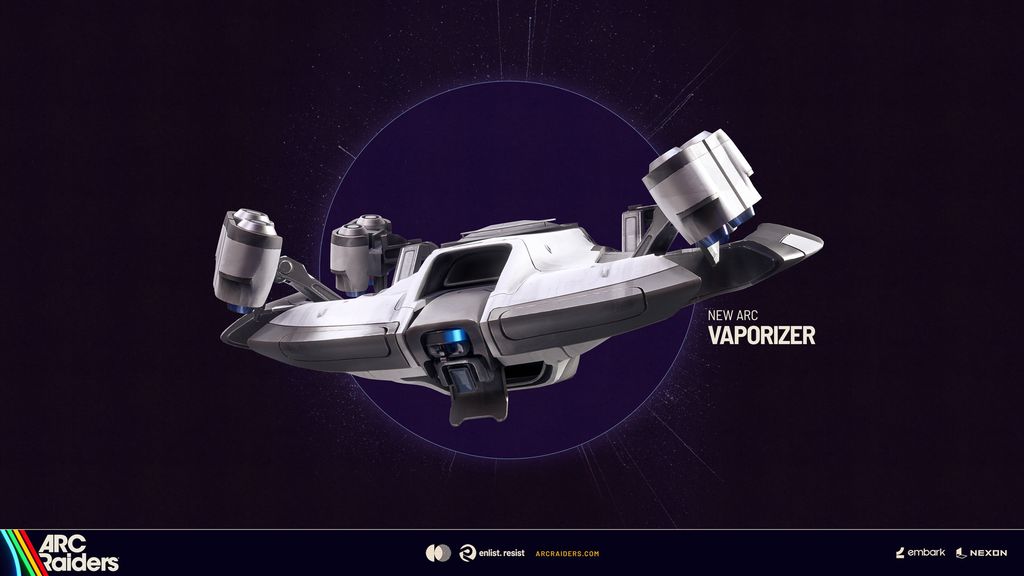
Then there's the Vaporizer, the new flying ARC type that earned its name honestly. Equipped with a lethal laser and erratic flight patterns, the Vaporizer doesn't play by the rules that experienced raiders have internalized over the past four months. It appears in groups, punishes players who rely on ground-level cover, and demands vertical awareness that most loadouts weren't built for.
PC GamesN's Paul Kelly captured the vibe well in his early impressions, noting the update "knocked me off kilter — in a good way" and successfully recreated "feelings of vulnerability absent since his early hours with the game." That's exactly what a live-service game needs from its third major update: a reset on complacency.
New Weapons: The Canto and Dolabra
Two new guns join the arsenal, and both seem deliberately designed for the threats Flashpoint introduces.
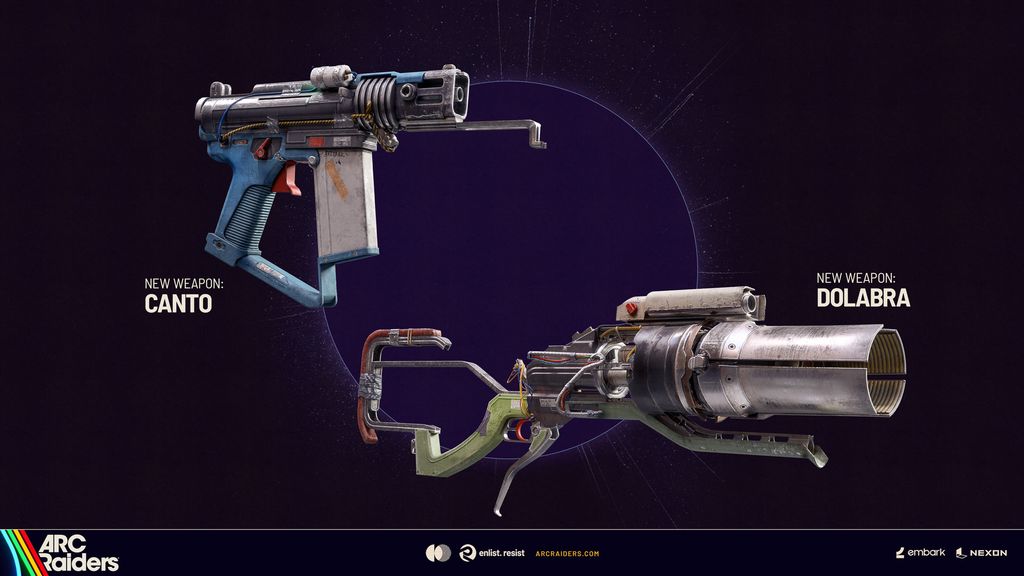
The Canto is a rare-tier submachine gun running medium ammo. It's positioned as a close-quarters option for clearing ARC enemies while maintaining enough distance to survive the encounter. Medium ammo is a deliberate choice — it's more available than energy cells but packs more punch than light ammo, making the Canto a practical workhorse rather than a situational pickup.
The Dolabra is the more interesting addition. This legendary energy shotgun features a variable focus mechanic, letting you toggle between a wide burst and a focused funnel of electricity. The wide spread handles groups of smaller ARC units; the focused mode punches through armor plating on heavier targets. Embark specifically notes the Dolabra excels inside Close Scrutiny operations, which makes sense — you'll want something that can crack through the ARC units swarming the Assessor without burning through rare ammo types.
The Surge Coil rounds out the new equipment as a rare deployable. Drop it and it periodically electrifies its surroundings, shocking anything that drifts into its orbit. It's a perimeter defense tool — plant it at a chokepoint while you're looting the Assessor, and it buys you a few seconds of warning before another squad rolls in.
The Change Everyone Actually Wanted: Matchmaking
Buried in the patch notes, past the new enemies and weapons, sits the single line that generated the loudest community response: "Players who build their own loadout are more likely to join fresh servers."
The reaction on Reddit was immediate and emphatic. "F***ing FINALLY" became the headline sentiment, with GamesRadar reporting that "everyone couldn't be happier" about the change.
Here's why this matters. ARC Raiders has a free loadout system that lets players drop into raids with pre-built kits at no cost. It's a generous feature for new players, but it created a frustrating dynamic for experienced raiders who invest resources into custom loadouts. You'd spend time and materials building out your kit only to load into a server where most of the high-value loot had already been picked over by free-loadout players who arrived earlier and had nothing to lose.
Embark frames this as "part of an ongoing look at free loadout usage and how it impacts the game," which suggests they've been monitoring the data and this is the first calibration pass — not necessarily the last. It's a measured approach that doesn't punish free-loadout users directly but gives invested players a better shot at the loot they're risking real resources to chase.
Shredders Spread Across the Map — And Not Everyone's Happy
This is where the community consensus fractures.
Shredders, the aggressive ground-based ARC enemies previously confined to Stella Montis, now appear across Blue Gate, Buried City, Spaceport, and under specific conditions in Dam Battlegrounds. From Embark's perspective, this expands the threat matrix and keeps experienced players on their toes across every map.
From the community's perspective? Some players see this as a recycled enemy being counted as new content. "If adding the shredder to another map is their way of doing an update then I will happily play Marathon for now until they actually bring new stuff," wrote one player, voicing a frustration that surfaced repeatedly in community discussions. Another commenter on PC Gamer cut straight to it: "Shredders are the new Arc aren't they."
The criticism isn't entirely fair — Flashpoint does introduce a wholly new enemy in the Vaporizer, plus the Assessor as a new mechanical presence. But the optics of spreading an existing enemy across new maps as a bullet point in a content update are tough when your player base is already anxious about content velocity. Embark's Escalation roadmap promised new ARC threats with each update, and while the Vaporizer delivers on that, padding the list with Shredder redistribution invites skepticism.
There's a reasonable counter-argument: Shredders on new maps do create different combat encounters because terrain and ARC composition vary by location. Fighting Shredders in Buried City's tight corridors hits differently than the open terrain of Stella Montis. But the community isn't wrong to want that distinction articulated rather than assumed.
Quality of Life: Crafting Gets the Overhaul It Needed
The patch notes are dense with quality-of-life improvements, and the crafting changes deserve specific attention because they address one of the game's most persistent friction points.
Previously, crafting required constant tab-switching to check material sources, recycle unwanted gear, and purchase missing components. Patch 1.22.0 consolidates all of this into a single interface. You can now acquire materials directly from the crafting screen — the system shows you where to get what you're missing (recycling, refining, or purchasing) and lets you handle it without leaving the menu.
This sounds minor on paper. In practice, for a game built around the loop of raid → extract → craft → raid, removing two or three extra menu navigations per session compounds into a meaningfully smoother experience. Live-service games live and die on these micro-frictions, and Embark clearly heard the feedback.
Other notable quality-of-life additions:
- HUD visibility modes for console players — Visible, Crosshair-Only, Crosshair & Interactions, or Hidden
- Matchmaking timer now visible on all screens, not just the queue
- Stash value displayed in inventory so you can see what your haul is worth before deciding to extract
- Ziplines and ladders now auto-drop carried items, preventing the awkward exploit of hauling carryables through movement shortcuts
- Free Augments now recycle into 6 plastic and 6 rubber parts, giving them actual material value instead of being vendor trash
Scrappy Gets Fed: The Companion Rework
The Scrappy feeding system is more significant than it sounds. Your robotic companion now collects loot based on what you feed it, with different food types incentivizing different collection behaviors and higher-value drops for consistent feeding.
This turns Scrappy from a passive follower into an active economy tool. Feed it strategically, and it becomes a secondary loot stream that compounds over the course of a raid. Ignore it, and you're leaving value on the table. It's the kind of system that rewards engagement without punishing casual players — you can still play without ever feeding Scrappy, but attentive raiders get a measurable advantage.
The Player Project: High-Gain Antenna
Flashpoint introduces the Player Project system with its first community challenge: the High-Gain Antenna. The setup is narrative-driven — NPCs Celeste and Shani need the community to collectively gather resources to build surveillance equipment tracking "strange shapes in the sky." Completion unlocks rewards for all participants.
Community-driven progression systems are a proven retention tool in live-service games. Destiny 2's community challenges and Helldivers 2's galactic war both demonstrated that shared objectives create social investment beyond individual session loops. Whether ARC Raiders' version has enough mechanical depth to drive the same engagement depends on reward quality and how transparently Embark communicates progress.
Balance Changes: Small Tweaks, Big Implications
The balance adjustments in 1.22.0 are surgical rather than sweeping:
- Rocketeers take less collision damage and are no longer instantly destroyed when stunned. This is a meaningful buff to one of the mid-tier ARC threats — Rocketeers were previously easy to cheese by stunning them into terrain.
- Firefly spawn rates reduced for multi-spawn scenarios. Firefly swarms were a known frustration point, particularly for solo players.
- ARC detection speed increased for players who are very close and directly in front of enemies. This punishes face-checking and rewards flanking — a good change for tactical play.
- Locked room loot values increased with scaling based on key rarity. Higher-tier keys now feel proportionally more rewarding, which addresses the complaint that difficult-to-find keys didn't justify the loot behind them.
The Bigger Picture: Is the Cadence Enough?
Strip away the individual features and the core question remains the same one that's hung over ARC Raiders since February: is one content update per month enough to sustain an extraction shooter in 2026?
The numbers tell a complicated story. A 50%+ player count decline over four months sounds alarming, but 115,000+ daily peaks is still a population most live-service games would kill for. The decline isn't a cliff — PC GamesN described it as "a steady affair" with "no cliff, no turning point," suggesting natural attrition rather than a catastrophic event. Players who consumed all available content moved on. That's normal.
What's not normal is the competitive pressure. Marathon is looming. The Finals continues to iterate. Even Escape from Tarkov's Arena mode has been pulling extraction shooter fans. ARC Raiders can't just retain players — it needs to give lapsed raiders a reason to reinstall.
Flashpoint makes a reasonable case. Close Scrutiny is a real innovation for the genre, the Vaporizer adds real threat variety, the crafting overhaul removes daily frustrations, and the matchmaking change addresses one of the community's longest-running complaints. Paul Kelly's assessment that the update "doesn't add anything huge, like a new map, but it's just enough that I think it will bring players back before the Riven Tides update next month" feels accurate.
The question is whether "just enough" is a sustainable strategy. Embark has explicitly confirmed that PvE engagement data is now a "primary driver" for the studio's roadmap, which suggests they're reading the room on what their player base actually wants. The Riven Tides update — the next item on the Escalation roadmap — needs to deliver something structurally larger. A new map, a new mode, or a significant expansion of the extraction loop.
The Cadence Test
Flashpoint is a solid B+ update. Close Scrutiny and the Vaporizer add genuine tactical depth. The crafting and matchmaking changes fix daily frustrations. The Scrappy feeding system gives veterans a new optimization layer. If you're still playing ARC Raiders, this patch makes the game meaningfully better.
But the Shredder redistribution controversy shows how thin the margin for error has become. When your community tracks content velocity with a stopwatch, every line in the patch notes gets scrutinized. Spreading an existing enemy across new maps is defensible design — but the framing matters as much as the substance, and Embark's presentation invited the skepticism it received.
The real evaluation of Flashpoint won't happen this week. It'll happen in the weeks between now and Riven Tides — the same kind of gap that bled the player count from 481,000 to 115,000 in the first place. Good content on a slow cadence is how live-service games lose audiences. Embark just proved they can deliver quality. Now they need to prove they can deliver frequency.
Sources
- ARC Raiders Official Patch Notes 1.22.0
- ARC Raiders Flashpoint Content Update
- PC GamesN: "The new Arc Raiders Flashpoint update brings back that early-game fear"
- GamesRadar: Custom loadout matchmaking change community reaction
- PC Gamer: Community reaction to Shredder expansion
- PC Gamer: Flashpoint crafting and Scrappy changes
- PC GamesN: Arc Raiders player count March 2026
- Vice: Arc Raiders Flashpoint Update

Founder of GGS Blog and Site Reliability Engineer at Box. I write about gaming, AI in gaming, and game development with a technical lens — 10+ years in software engineering, 20+ years as a gamer. My work focuses on what the tech actually means for players.
Never miss a post
Subscribe to the GGS Blog newsletter for gaming news, tech insights, and AI in the game industry — delivered straight to your inbox.
Free. No spam. Unsubscribe in one click.
Comments
What to Read Next
Continue exploring our coverage of gaming, technology, and AI.
 Gaming
GTA 6 Is $80. Here's What Rockstar Still Hasn't Told You.
Rockstar confirmed GTA 6 pricing at $79.99 Standard and $99.99 Ultimate. The silence around PC, regional pricing, and GTA Online structure tells a bigger story than the price tag. Here's how to think about the $80 ask.
 Gaming
GTA 6's Cover Art Is Beautiful. June 25 Is About Something Else.
Rockstar revealed the official GTA 6 cover art on June 18, and it's a confident piece of franchise mythology. But pre-orders opening June 25 carry a question bigger than bonus content: is this the moment gaming crosses the $100 line?
 Gaming
I Hadn't Touched Spider-Man in Years, Then Spider-Man 2 Yanked Me Off the Roof
I came back to web-swinging after a long break, expecting to bounce off it. Instead I lost a whole weekend gliding over Marvel's New York and grinning like an idiot.