
Hades Is Better Before You're Good at It — and That's the Point
I saw Hades 2 on sale last week — $23.99, down from $29.99 on Steam. Checked the store page, noticed I'd never played the original, found it sitting at $6.24 on Steam (75% off, PC Gamer called it the biggest sale ever for the title). Six dollars. Bought it without thinking. Figured I'd poke around for an hour.
That was forty-something deaths ago.
I'm not writing this as someone who has escaped the Underworld. I haven't. First escape typically takes new players somewhere between run 20 and run 50 — Hades veterans treat that range as orientation, not failure. I'm somewhere in that window, and I'm not embarrassed to say it. What I want to write about is what I've noticed while dying, because there's something happening in those early runs that I didn't expect from a six-dollar impulse buy.
Hades is a better game before you're good at it. The deaths — the dying-constantly phase that every new player goes through — are not the price you pay to get to the good parts. They are the good parts. That's a design claim worth defending.
What You're Actually Buying for Six Dollars
Supergiant Games had 16 people when Hades launched — Greg Kasavin confirmed "fewer than 20" during development in a Game Developer interview. That fact still stops me when I think about what they built here. Hades released September 17, 2020, and by most measurable definitions of success, it became one of the defining games of that year.
93 on Metacritic, universal acclaim. 99% of critics recommended it on OpenCritic. Steam: 301,000+ reviews at 98% positive — "Overwhelmingly Positive," the highest tier Steam has. Estimated sales sit around 7.7 million copies (Supergiant confirmed "over 1 million" publicly). It won Game of the Year at BAFTA, D.I.C.E., GDC Choice Awards, NY Game Awards, SXSW, Best Indie and Best Action at The Game Awards 2020. It became the first video game to win a Hugo Award — the Hugo for Best Game Writing in 2021 — and also won the Nebula Award for Best Game Writing that same year.
That's not a good indie game doing well above expectations. That's 16 people making something that stood alongside every AAA game released that year and beat them on every critical axis.
Six dollars.
The Dying Is the Design
Here's what surprised me within the first hour. I died, got sent back to the House of Hades, and expected a loading screen or a respawn confirmation. Instead, Nyx — the goddess of night, all deep violets and cold gold — spoke to me. Acknowledged my death. Not generically. Specifically.
Zagreus, the protagonist, responds like a person who's been through this before. He's voiced by Darren Korb, who also composed the entire soundtrack — a detail that sounds impossible until you hear how the music shifts when a character enters the room. Korb did both. The same person responsible for the soundtrack you'll leave running after you close the game is also the voice you hear every time Zagreus cracks a line at the gods.
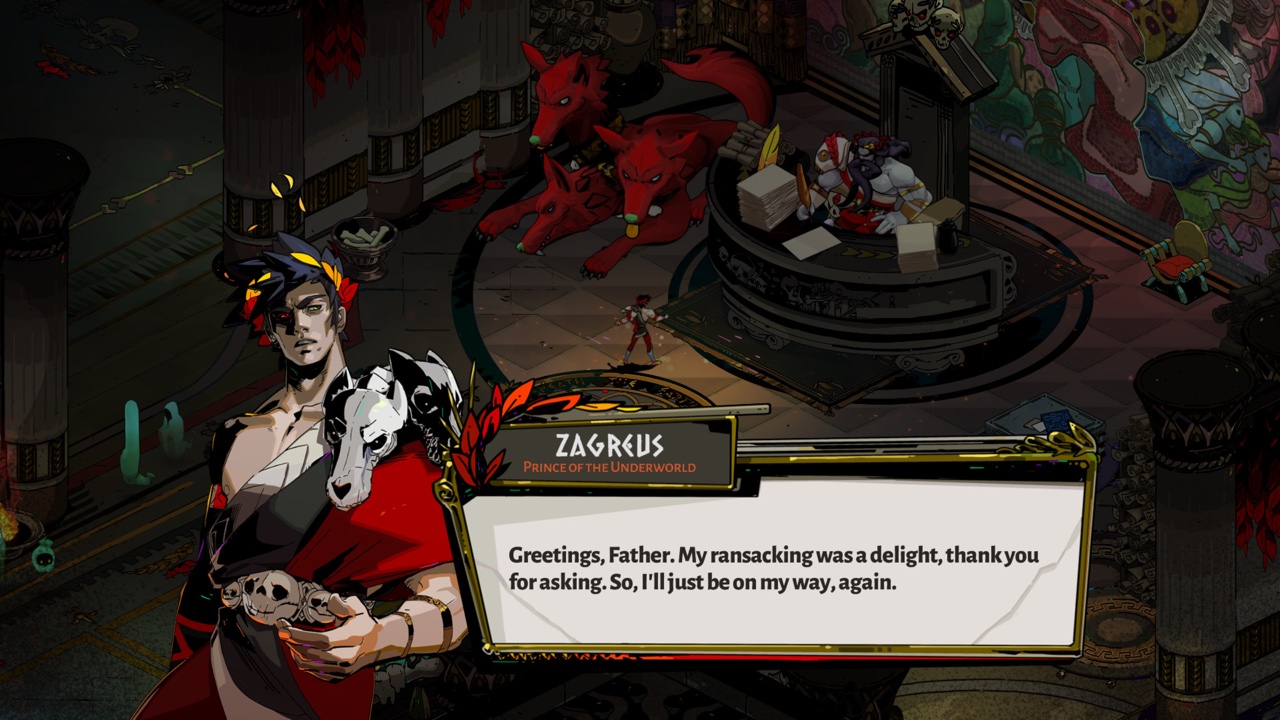
Because canonically, he has. The fiction of Hades doesn't treat death as a glitch in the narrative. It treats it as the narrative. Zagreus literally dies, returns, and everyone in the House remembers it. Characters reference your current run's boon choices. Bosses evolve their dialogue the more times you face them. Logan Cunningham voices Hades, Poseidon, Charon, and the Narrator with such specificity that each character sounds like a distinct personality rather than a hired voice doing variations on "god voice."
This was a deliberate structural decision by Greg Kasavin, Hades' creative director. In a Game Developer interview, Kasavin described his goal as making "players understand that failed runs are actually okay" — and crucially, he built that into the fiction itself rather than just slapping a tutorial tip on the loading screen. The failure state is canonized. The world processes your deaths. The story continues through them.
What this does mechanically is remove the sting of dying in a way that no reward system could match. You don't lose narrative progress when you die. You gain it.
Everything New Is in the Dying
Each run, gods from the Olympian pantheon offer you boons — power-ups that modify your attacks, calls, and cast. Artemis gives you critical strike chances and tracking arrows. Dionysus coats enemies in hangover stacks. Poseidon knocks things away with hydraulic force and drops gems when they hit walls. Ares fills your blades with Doom, a delayed burst of damage.
These aren't just numbers. Each boon arrives with voiced lines that carry the god's personality. Choosing Artemis's boon isn't just a mechanical decision — it's a stance on character. Dionysus is breezy and a little dismissive. Poseidon is magnanimous and slightly oblivious to how self-congratulatory he sounds. Ares is severe. Every run, you're assembling a build and deciding whose company you want to keep.
The NPC affection system deepens this. You give Nectar to characters — Nyx, Dusa, Thanatos, Achilles — and their dialogue opens up across subsequent runs. This is the genius of the architecture: the game gives you reasons to want to die and return. Not just to get stronger. To see what Nyx says next. To check if Thanatos is in the courtyard again. I've died specifically because I was distracted by a new line of dialogue and didn't dodge a Satyr's charge. I don't regret it.
The early runs — when the dialogue is all new, when every god encounter is your first with that character, when every room might hide a mechanic you haven't seen before — are the richest the game gets. Steam reviewers say things like "30 hours in and still haven't seen dialogue repeated." That's the promise. But the first 10 to 20 runs are the concentrated version of it. You're drowning in new information delivered by voice actors operating at peak craft. The dying is how you stay submerged.
The Art Style Deserves Its Own Paragraph
I keep stopping during runs to look at things.
Jen Zee's portrait work — the character illustrations that appear during dialogue — is unlike anything else in games right now. Each character is rendered with a painted quality that feels closer to book cover illustration than game art. The gods are imposing: Ares reads as violence personified, Aphrodite as someone who has never once considered that you're not looking at her. Zagreus is rendered with enough softness to read as young against the ancient weight of everyone around him.
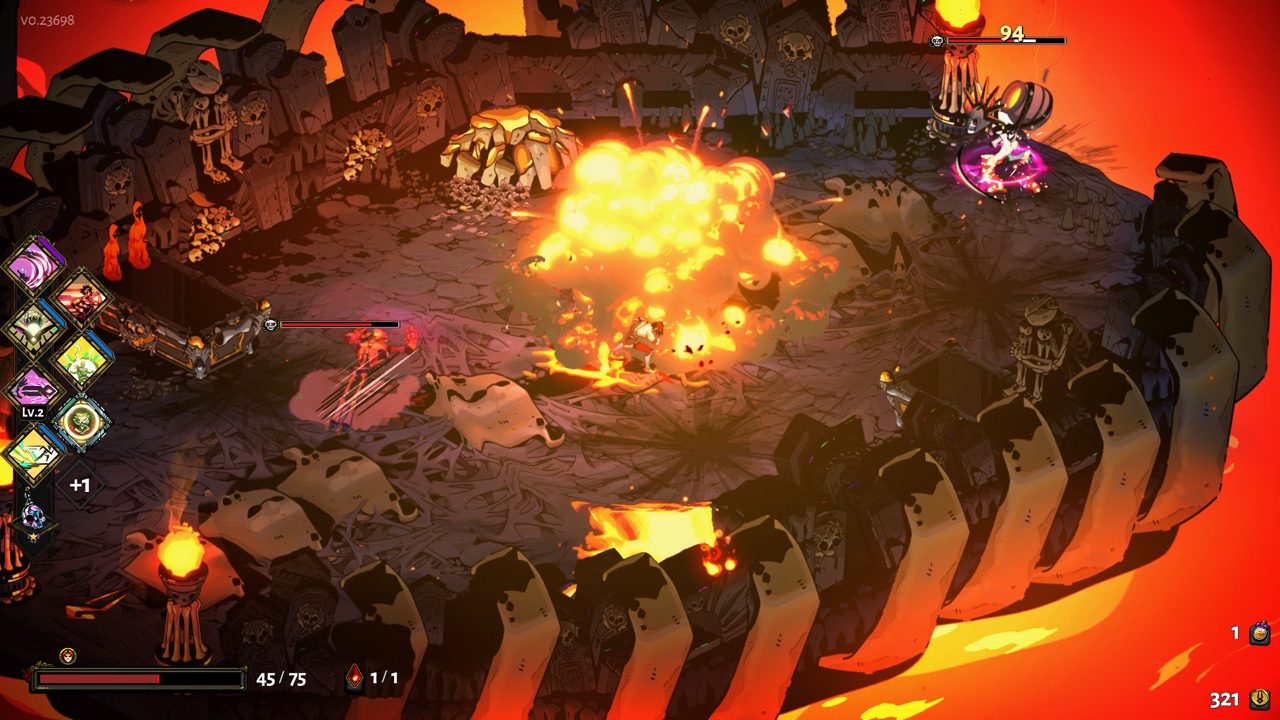
The underworld biomes — Tartarus, Asphodel, Elysium, the Temple of Styx — shift aesthetic register as you descend. Tartarus is oppressive purple-black stone. Asphodel opens into volcanic oranges with ash drifting through the air. Elysium goes full marble colosseum, heroes of myth lounging around like it's a retirement community.
Sixteen people made this. Jen Zee and the Supergiant art direction team produced assets that compete with studios ten times their size — and the portrait work would hold up as standalone prints.
The Boss Fights Are the Curriculum
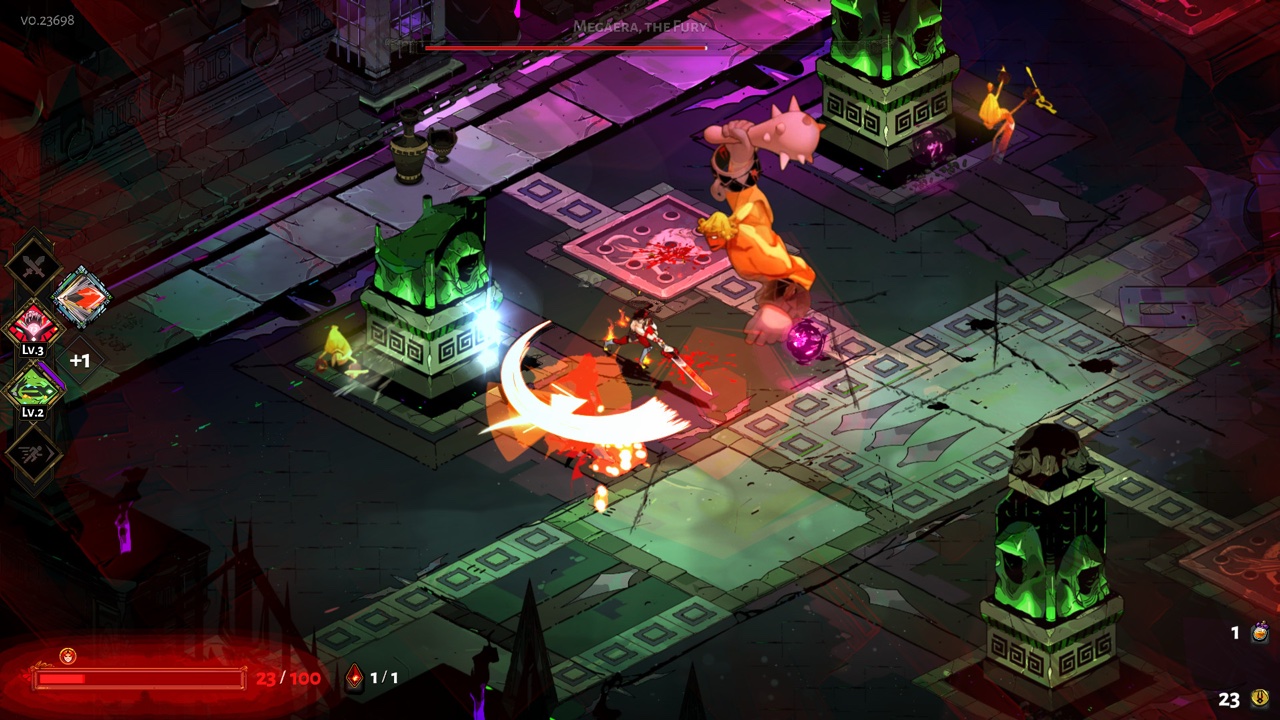
Each biome ends with a boss. The first real test is the Meg fight — Megaera, one of the Furies, who punishes you for not learning to dodge and who has something to say about your failure every single time you face her. By the time you beat her (not if — when, it just takes however many runs it takes), you've absorbed her attack patterns so deeply they feel like muscle memory. You didn't study them. You lived through them.
The later fights escalate this. Theseus and Asterius in Elysium — the game's fan-favorite boss encounter — are two characters with distinct personalities, complementary attack patterns, and the single most annoying pre-fight speech in gaming. Theseus, the legendary king of Athens, calls upon the gods to bless him mid-fight. The gods you've been building relationships with throughout the run. The fight is a mechanical test and a thematic statement simultaneously: Zagreus has to use the boons of his family to defeat a hero who thinks the gods favor him.
I haven't beaten them yet. The first few attempts were humbling.
The One-Life Structure Is the Tension Engine
Each run is a single life. There are no mid-run saves, no checkpoints between chambers. When you die, you return to the House of Hades and the run resets. This is not a limitation to tolerate — it's the entire reason the game works.
Without the one-life structure, there's no tension in each room. The chamber that contains three Witches and two Bloodless would be an inconvenience in a game with checkpoints. In Hades, it's a threat.
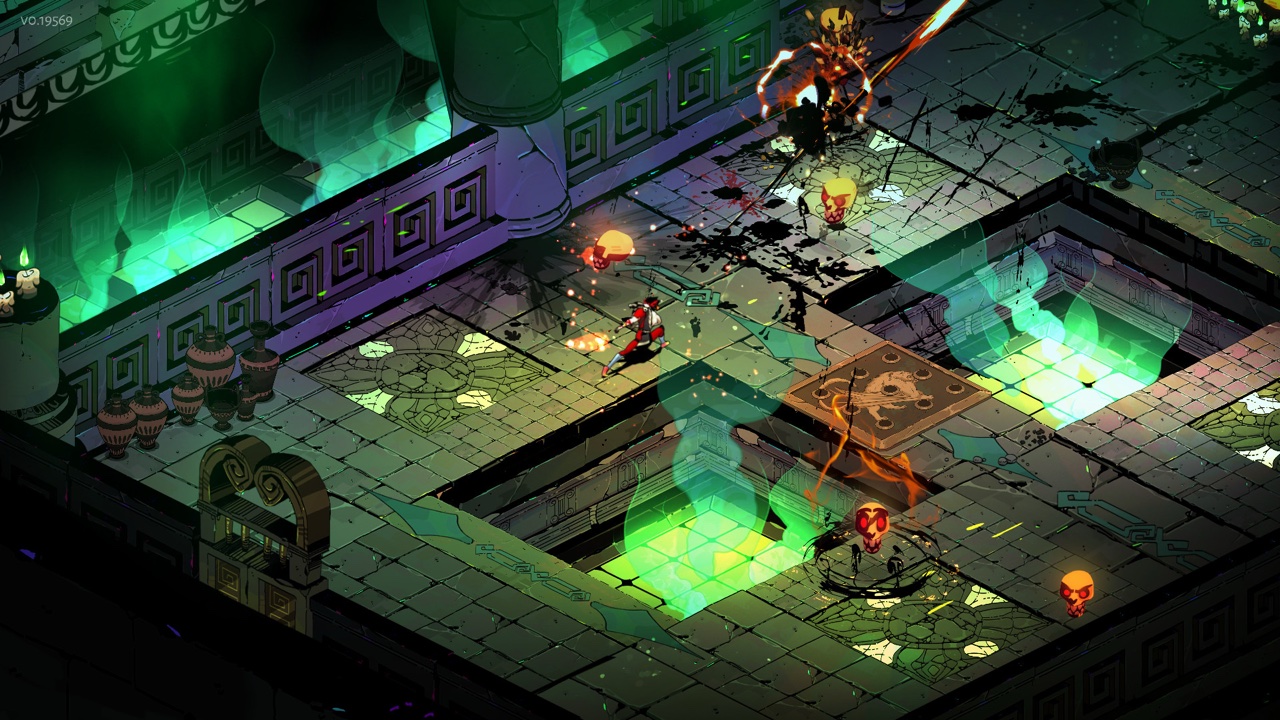 You have to play it. You have to make decisions — dodge-roll timing, boon ability cooldowns, which enemy to prioritize — with actual stakes attached. The fact that a bad read on a Satyr's attack pattern two rooms before the boss can spiral into a run-ending death is what makes the whole system feel meaningful.
God Mode exists for players who want to reduce that friction. It stacks damage reduction with each death, making the game progressively easier after repeated failures. Kasavin designed this openly, not as a shame spiral — it's in the menu, described without judgment, available to everyone. The community has normalized it. The point isn't to gatekeep mastery; it's to make the story accessible to players who want the narrative without the punishing difficulty curve. That's a design choice worth acknowledging: Supergiant built a game about failure that is architecturally compassionate about failure.
Zagreus Dies. The Story Doesn't Reset.
What Kasavin figured out — and what I think explains why Hades succeeded at something most roguelites don't — is that he solved the narrative problem of the roguelite form.
Most roguelites have weak or nonexistent narratives because narrative requires continuity and roguelites require starting over. Hades collapsed the contradiction by making Zagreus's death the narrative throughline. You're not resetting. Zagreus is dying and coming back, and the story advances through that. The failed runs aren't noise — they're the mechanism by which the world reveals itself.
This is why the game is better before you're good at it. A skilled player who breezes through the biomes in a handful of runs sees less of the game. They spend less time in the House of Hades between attempts. They have fewer conversations. They receive fewer gifts of Nectar, accumulate fewer relationship beats, hear less of Korb's music (which shifts and layers dynamically as you move through the world). Mastery compresses the experience. The struggle extends it.
I say this knowing I'll probably feel differently when I finally escape. Victory has its own pleasures. But the accumulation of small revelations in the dying phase — a new Nyx line, a god's boon I hadn't tried before, a boss move that I finally parsed in time to dodge — has been the most consistently rewarding part of the game so far.
I'll update this post if and when I complete my first escape. I want to be honest about that. I'm writing from inside the experience, not from the other end of it.
Hades 2 and Why Hades 1 Still Matters
Hades 2 released fully on September 25, 2025, and hit Metacritic 95 — the highest-rated game of 2025, according to NME. It launched on PS5 and Xbox on April 14, 2026, including Xbox Game Pass day one. The protagonist is Melinoe, Zagreus's sister. Different setting, different cast. You don't need to play Hades 1 to play Hades 2.
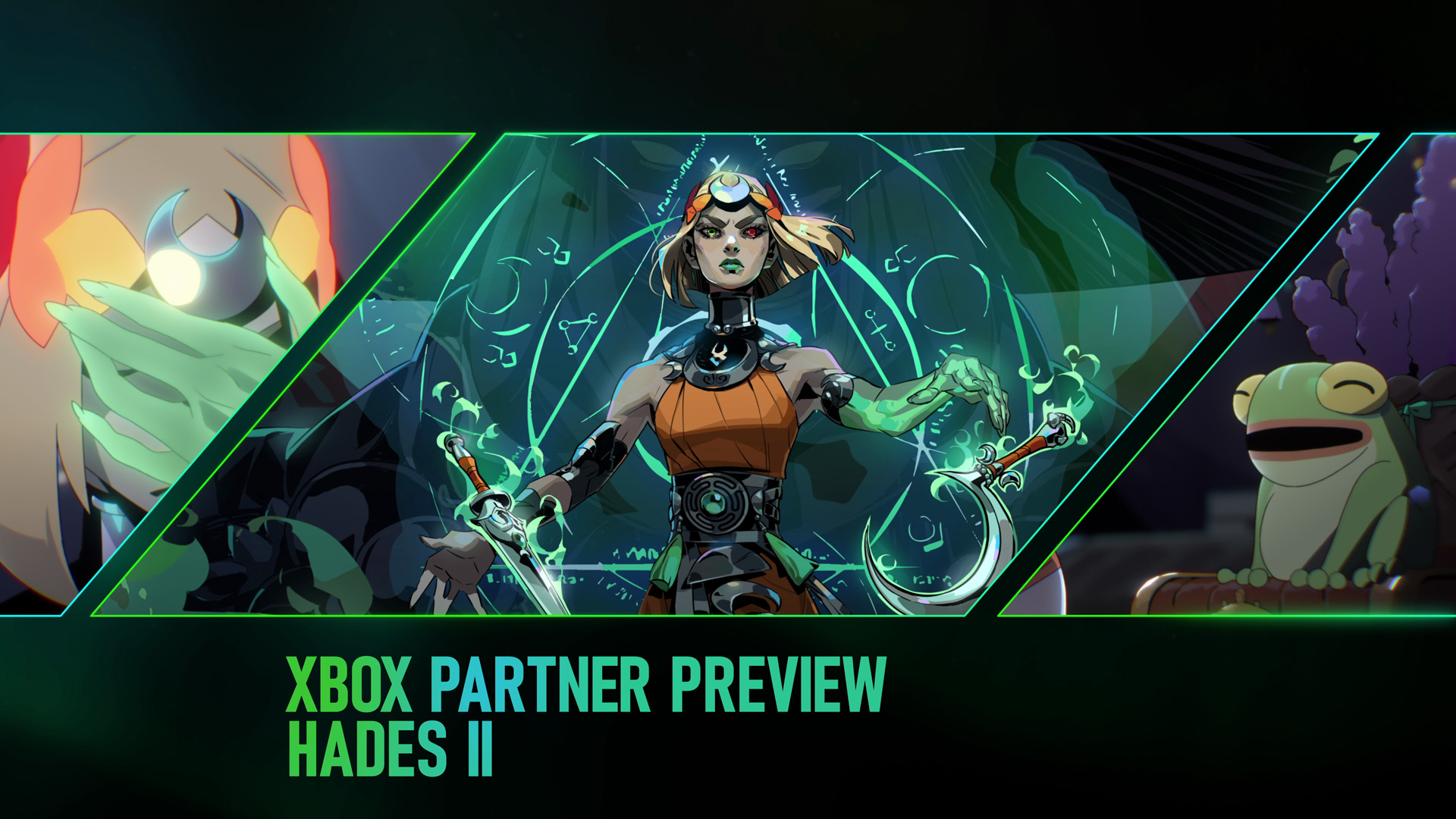
But there are thematic threads that carry over. Relationships that mean more if you know the first game. The franchise has proven staying power across two titles and five years — and the original, available right now for $6.24, is the foundation that makes the sequel's world feel earned rather than adjacent.
If you're doing what I did — looking at Hades 2 and checking whether you should play the first one — the answer is yes. Six dollars is not a financial decision. It's a rounding error on dinner. The question is just whether you want to spend your next forty evenings dying pleasurably in the Underworld.
I do. Apparently.
Who Hades Doesn't Work For
Here's the honest version of the counterargument, because it exists and it's legitimate.
Players who have already sunk time into roguelites with deeper mechanical systems — The Binding of Isaac, Dead Cells — sometimes find Hades' boon choices straightforward. The variance between runs is lower than in games with more chaotic build generation. If you want the combinatorial madness of synergy-hunting in Isaac, Hades' curated boon offerings can feel guided to the point of thinness.
The repetition fatigue is real for players who've heard the early House dialogue many times but haven't escaped yet. If you're on run 35 and still bouncing off the final boss, the comedy of Megaera's reaction to your death stops landing the same way. The game knows this — it keeps adding new lines further into the relationship arc — but there's a valley between "everything is new" and "I have mastered this" where some players get stranded.
The structure also doesn't end at the first escape. The full story requires multiple successful runs. Players who treat the first clear as completion will feel like the goalposts moved. In a sense, they did. Kasavin's design asks you to run it again, and again. For some players that's the point. For others it's an ask they don't want to honor.
The biome structure is fixed — Tartarus, Asphodel, Elysium, Temple of Styx, same order every time. There's no procedural world variety. The rooms shuffle, but the world doesn't. If you want your roguelite to feel structurally unknowable, Hades gives you room-level randomness within a fixed geography. Some players find that elegant. Others find it limiting.
Every one of those critiques lands. None of it changes what I've been doing for the past week.
$6.24. Go die a few times.
Sources

Founder of GGS Blog and Site Reliability Engineer at Box. I write about gaming, AI in gaming, and game development with a technical lens — 10+ years in software engineering, 20+ years as a gamer. My work focuses on what the tech actually means for players.
Never miss a post
Subscribe to the GGS Blog newsletter for gaming news, tech insights, and AI in the game industry — delivered straight to your inbox.
Free. No spam. Unsubscribe in one click.
Comments
What to Read Next
Continue exploring our coverage of gaming, technology, and AI.
 Gaming
GTA 6 Is $80. Here's What Rockstar Still Hasn't Told You.
Rockstar confirmed GTA 6 pricing at $79.99 Standard and $99.99 Ultimate. The silence around PC, regional pricing, and GTA Online structure tells a bigger story than the price tag. Here's how to think about the $80 ask.
 Gaming
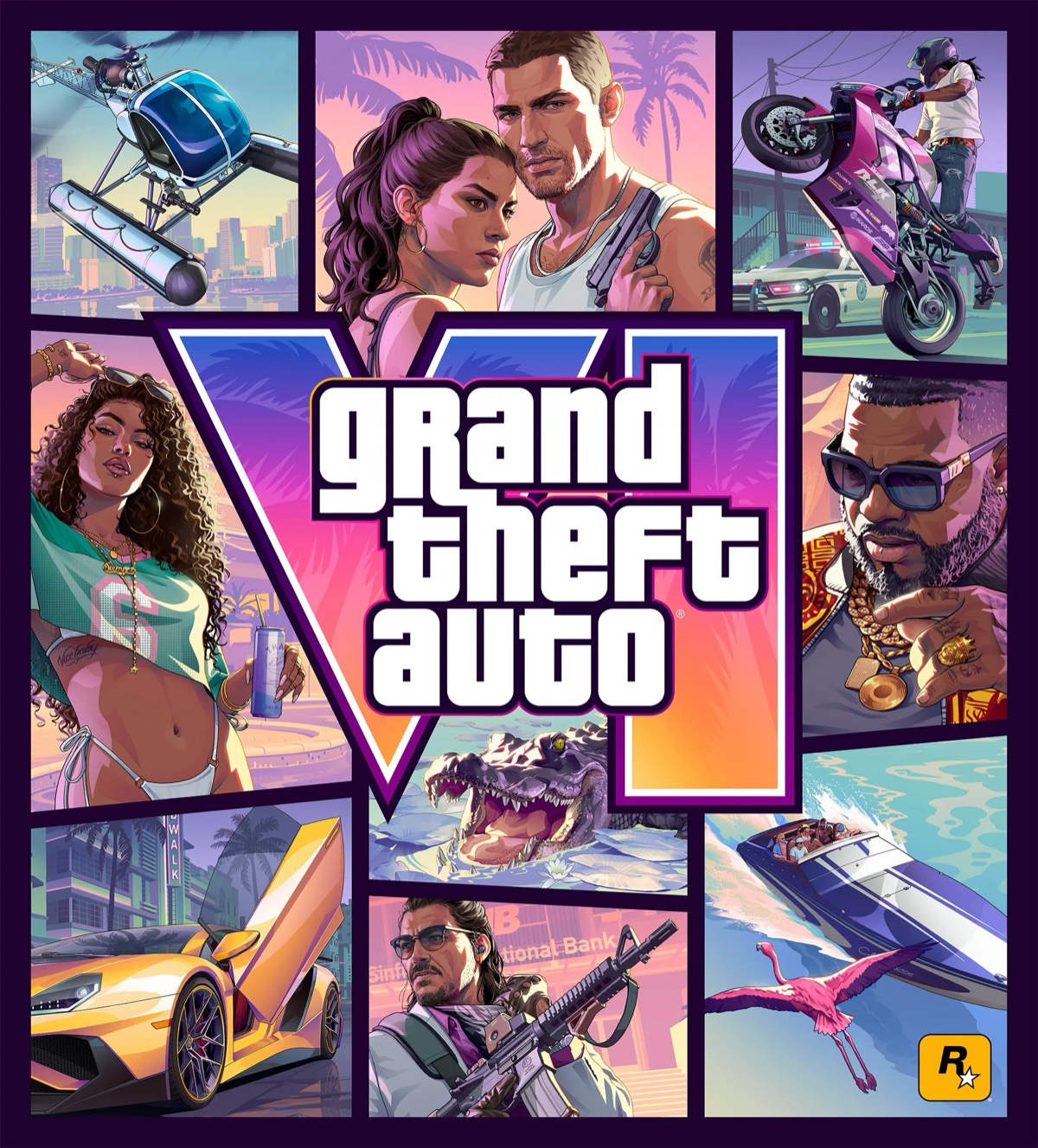
GTA 6's Cover Art Is Beautiful. June 25 Is About Something Else.
Rockstar revealed the official GTA 6 cover art on June 18, and it's a confident piece of franchise mythology. But pre-orders opening June 25 carry a question bigger than bonus content: is this the moment gaming crosses the $100 line?
 Gaming
I Hadn't Touched Spider-Man in Years, Then Spider-Man 2 Yanked Me Off the Roof
I came back to web-swinging after a long break, expecting to bounce off it. Instead I lost a whole weekend gliding over Marvel's New York and grinning like an idiot.