
March 2026 Is Quietly Stacked: The Biggest Releases and the Engine War Nobody's Talking About
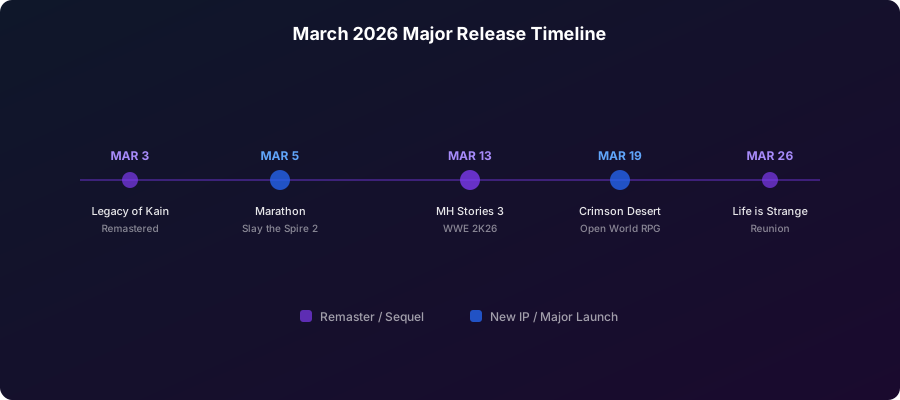
Somewhere between the holiday rush and E3 season, March has become the month where publishers quietly drop absolute heat and hope nobody notices the competition. March 2026 is no exception. In the span of four weeks, we're getting Bungie's reinvention of Marathon, Pearl Abyss's long-awaited Crimson Desert, Capcom's next Monster Hunter Stories, a Legacy of Kain remaster with lost content, Slay the Spire 2 in early access, and enough other releases to make your wallet physically recoil.
But that's not the only story this month. The GDC 2026 State of the Game Industry report dropped some genuinely significant numbers about the tools developers are actually using — and for the first time, Unreal Engine has pulled decisively ahead of Unity as the primary engine of choice across the industry.
Let's break down what's hitting shelves this month and why the engine data matters more than you might think.
Marathon: Bungie's $40 Bet on Extraction Shooters
Release: March 5 | PS5, Xbox Series X|S, PC
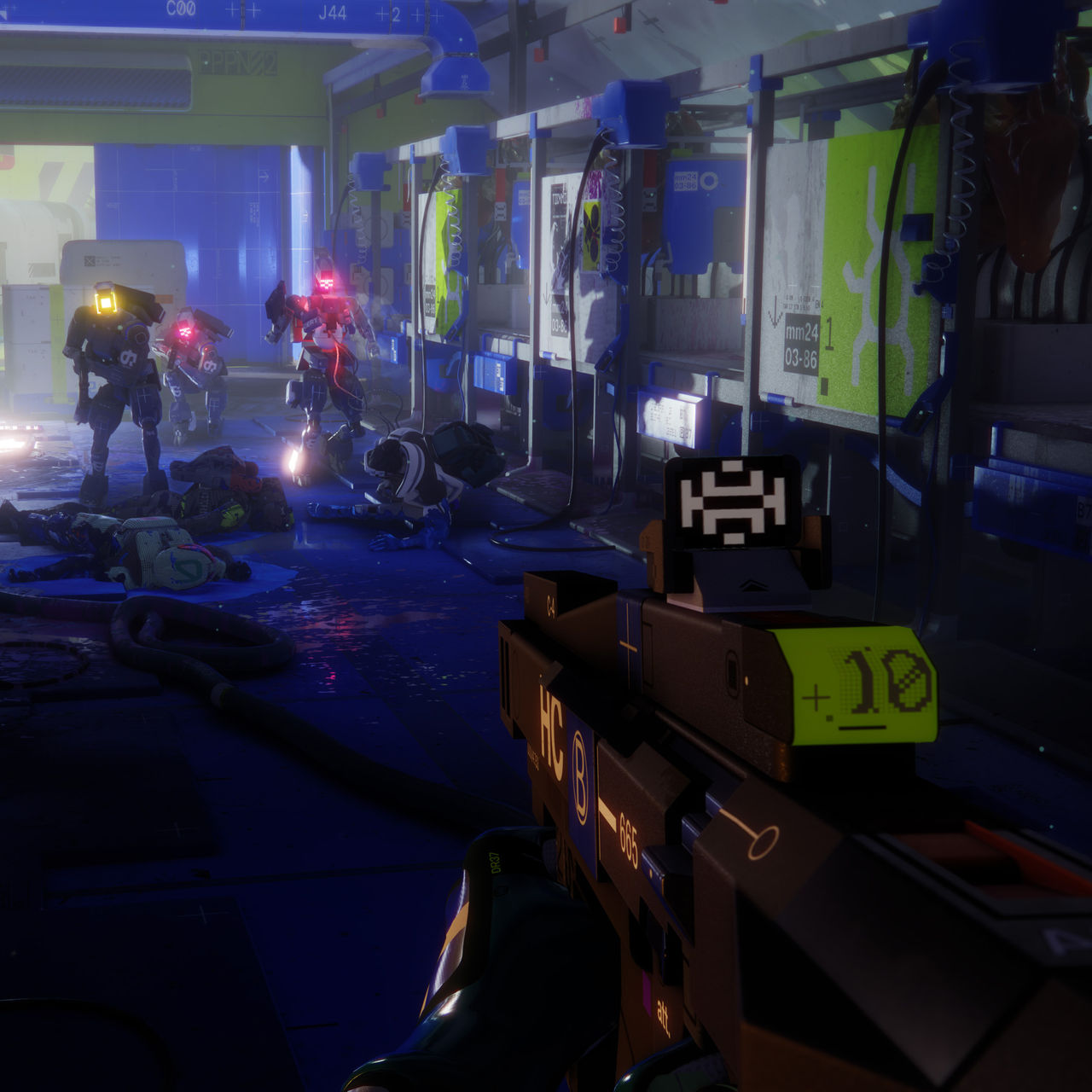
Marathon launched on March 5, and it's the most interesting gamble in the shooter space right now. Bungie took a 30-year-old franchise name, stripped away everything that made the original Marathon what it was, and built something entirely new: a PvP extraction shooter with loot mechanics, priced at $39.99 with a Season 1 pass included.
The pitch is straightforward. Drop into hostile environments as a Runner, grab valuable loot, fight other players (and AI threats), and extract before you lose everything. It's the Escape from Tarkov formula filtered through Bungie's signature gunplay and art direction — and early impressions suggest the shooting feel is exactly what you'd expect from the studio that built Halo and Destiny.
What makes Marathon worth watching isn't just the gameplay, though. This is Bungie's first non-Destiny release in over a decade, and it arrives at a moment when the studio desperately needs a win after years of layoffs and restructuring under Sony's ownership. At $40 with seasonal content updates planned (and no $70 price tag), it reads as a studio that's learned some lessons about player goodwill.
Whether Marathon can carve out space in a genre already crowded by Tarkov, The Cycle: Frontier's ghost, and Arc Raiders remains the open question. But if any studio can make extraction shooting feel mainstream, it's probably Bungie.
Legacy of Kain: Defiance Remastered — A Cult Classic Gets Its Due
Release: March 3 | PS5, PS4, Xbox Series X|S, Xbox One, PC
This one's for a very specific audience, and those people are losing their minds right now.
Legacy of Kain: Defiance Remastered dropped on March 3 with HD graphics, refined controls, a modernized camera system, and — here's the headline feature — restored lost levels and unreleased content from the original game. Crystal Dynamics didn't just upscale textures and ship it. They dug into the archives and brought back content that was cut over two decades ago.
The remaster also includes a photo mode, alternate character skins, and a comprehensive lore reader for anyone who wants to untangle one of gaming's most convoluted (and genuinely brilliant) narratives. You can toggle between the HD and original presentation at any time, which is the kind of respect for source material that fans rightfully demand from remasters.
But the real kicker? Legacy of Kain: Ascendance, a brand-new 2D action-platformer set in the same universe, launches on March 31. The Heart of Darkness Collection bundles both games together. Crystal Dynamics isn't just preserving Legacy of Kain — they're actively expanding it. For a franchise that many assumed was permanently dead, this is a remarkable month.
The Switch and Switch 2 versions got hit with a last-minute delay, which is unfortunate but not uncommon for Nintendo platform launches right now. Everything else is live and playable.
Monster Hunter Stories 3: Twisted Reflection — Capcom's JRPG Bet
Release: March 13 | PS5, Xbox Series X|S, Switch 2, PC
Capcom continues its strategy of making Monster Hunter work in every genre imaginable. Monster Hunter Stories 3: Twisted Reflection brings the franchise's turn-based RPG spinoff to its third entry, and this time it's going bigger on narrative ambition.
You play as the heir to the kingdom of Azuria, the sole Rathalos Rider in the land, thrust into a quest to uncover the truth behind the Crystal Encroachment — an environmental crisis pulling two nations toward war. The story involves twin Rathalos bearing a marking tied to a 200-year-old civil war, extinct species returning, and the kind of political fantasy setup that the Stories series has always handled better than it gets credit for.
The game launches across PS5, Xbox, Switch 2, and PC on March 13 with free day-one DLC including the Gold Circlet accessory and a layered armor set. Three editions are available: Standard, Deluxe (with extra outfits and a side story), and Premium Deluxe (with the full DLC pack).
What's notable here is the Switch 2 launch. Monster Hunter has always been a system-seller for Nintendo hardware, and Stories 3 is one of the first major third-party titles positioning itself as a Switch 2 showcase. Capcom clearly believes the new hardware can handle what they're building, and the Capcom Spotlight presentation earlier this week — which also teased Pragmata — suggests they're going all-in on the platform.
Crimson Desert: The Open-World Dark Horse
Release: March 19 | PS5, Xbox Series X|S, PC, Mac
If there's one game on this list that could genuinely surprise people, it's Crimson Desert.
Pearl Abyss has been showing this game since 2020, and for years it existed in a weird liminal space — was it a Black Desert Online prequel? A standalone RPG? A live-service game? The answer, finally, is clear: Crimson Desert is a single-player open-world action-adventure set on the continent of Pywel, and it has absolutely nothing to do with Black Desert's MMO infrastructure.
The game follows Kliff, a member of a mercenary group called the Greymanes, across five distinct regions. Pearl Abyss claims the world is "at least twice as big as the playable area of Skyrim," which is the kind of comparison that either excites you or makes you nervous. The combat is fast-paced and action-driven, built on Pearl Abyss's proprietary BlackSpace Engine, and preview coverage has been overwhelmingly positive.
Here's what makes Crimson Desert especially interesting: it went gold weeks ago, it has over 2 million Steam wishlists, and the review embargo lifts a full day before launch. That last detail is important. Publishers who are confident in their product let reviews go live early. Publishers who aren't impose day-one embargoes or later. Pearl Abyss is letting journalists publish reviews on March 18, a full 24 hours before the game is available. That's a flex.
The PS5 Pro version supports PSSR 2 with high-framerate 4K visuals, though it's worth noting that all preview coverage so far has been based on the PC build. Console performance remains an open question until launch day.
The Sleeper Hits: Slay the Spire 2, WWE 2K26, and More
March isn't just about the headliners. Several other releases deserve attention.
Slay the Spire 2 (March 5, PC Early Access) launched to Overwhelmingly Positive reviews on Steam — 97% positive from nearly 4,000 reviews on day one. The sequel to the genre-defining roguelike deckbuilder brings five playable characters (three returning favorites rebuilt from scratch), online co-op for up to four players, and a 1-2 year Early Access roadmap. Console versions targeting Switch 2, PS5, and Xbox are planned for the 1.0 release in 2027. If you own a PC, this is arguably the safest purchase of the month.
WWE 2K26 (March 13, PS5/Xbox/Switch 2/PC) boasts the largest roster in franchise history with 400+ Superstars and Legends, four new match types (I Quit, Inferno, 3 Stages of Hell, Dumpster), and a 2K Showcase mode following CM Punk's career. The Switch 2 launch is notable — this is one of the first sports games to ship on Nintendo's new hardware at parity with PlayStation and Xbox.
Life is Strange: Reunion (March 26) brings Max and Chloe back together at Caledon University, marketed as the conclusion to their story arc. Deck Nine is developing, with Square Enix publishing.
Scott Pilgrim EX (March 3) takes the beloved beat-em-up formula and adds time and space travel across Toronto. Planet of Lana 2: Children of the Leaf (March 5) continues the gorgeous side-scrolling puzzle adventure from Pearl Abyss. And the Mega Man Star Force Legacy Collection drops March 27 for anyone craving portable Capcom nostalgia.
The Engine War Nobody's Talking About
Now for the industry story that got buried under all these releases.
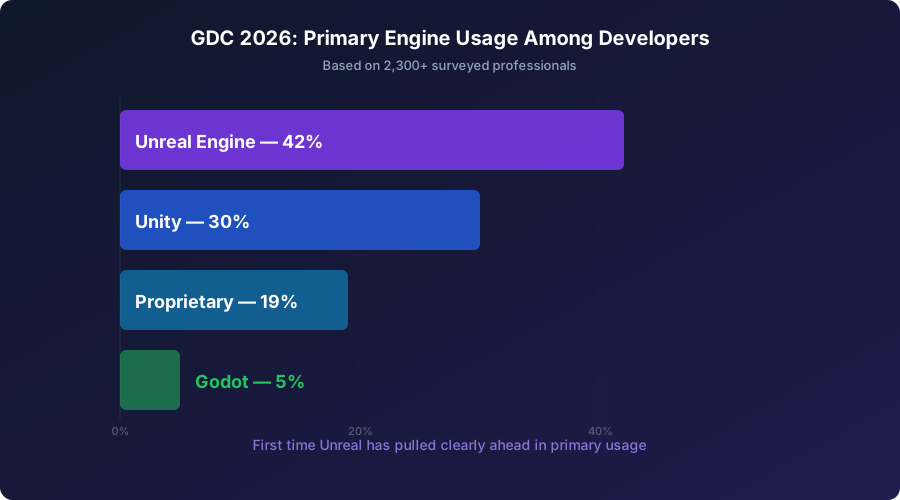
The GDC 2026 State of the Game Industry report surveyed over 2,300 developers, and the results contain a genuinely significant shift: 42% of developers now use Unreal Engine as their primary development tool, compared to 30% for Unity. This is the first time Unreal has pulled clearly ahead in the survey's history.
For years, Unity and Unreal traded the top spot depending on how you sliced the data. Unity dominated in mobile, indie, and free-to-play. Unreal dominated in AAA and high-fidelity console work. The overall numbers were always close enough that both companies could claim victory by picking the right metric.
That ambiguity is gone. Unreal now leads overall, and the breakdown by studio size tells the real story:
- AAA studios: 47% Unreal vs. Unity trailing significantly
- AA studios: 59% Unreal — the strongest lead in any category
- Indie studios: Unity still leads, with 54% of established indie developers sticking with the engine
- Free-to-play: 38% Unity, maintaining its edge in mobile and F2P
- Proprietary engines: 19% of respondents, mostly large studios with legacy tech
- Godot: 5% overall, 11% among indie respondents — small but growing
Why Unreal Is Winning
The shift didn't happen overnight, and it isn't just about graphical fidelity. Several factors are converging:
Unity's pricing crisis left scars. The runtime fee controversy in late 2023 shook developer trust in ways that Unity still hasn't fully recovered from. Even after walking back the policy, the damage was done. Studios that were evaluating their next project's engine in 2024 and 2025 chose Unreal at higher rates than ever before, and those decisions are now showing up in the 2026 data.
Unreal's tooling has gotten dramatically better for mid-sized teams. Historically, Unreal was overkill for anything below AAA. The engine was powerful but bloated, with a learning curve that scared off smaller studios. Epic has spent the last three years making Unreal more accessible through better documentation, streamlined workflows, and the maturation of Verse (their scripting language for Fortnite Creative / UEFN). The result: AA studios — the 20-80 person teams making mid-budget games — have flocked to Unreal at the highest rate of any segment.
The visual fidelity gap matters more than ever. With PS5 Pro, Xbox Series X enhanced patches, and Switch 2 raising the baseline for console graphics, studios are choosing the engine that gives them the most visual headroom. Unreal 5's Nanite and Lumen remain industry-leading, and the gap between what Unreal and Unity can produce at the high end has widened, not narrowed.
Fortnite Creative and UEFN created a talent pipeline. Thousands of developers learned Unreal's tools by building content for Fortnite. Those developers are now entering the professional workforce or starting indie studios, and they're bringing their engine preference with them.
What This Means Going Forward
This doesn't mean Unity is dying. 30% of the market is enormous, and Unity's strengths in mobile, F2P, and rapid prototyping remain real. The engine powers some of the biggest mobile games on the planet, and its asset store ecosystem is still unmatched for solo developers and small teams.
But the trend line is clear. If you're starting a new AA or AAA project today, Unreal is the default choice in a way it wasn't three years ago. The studios that haven't already committed to Unity are overwhelmingly choosing Unreal, and that momentum creates a self-reinforcing cycle — more Unreal developers means more Unreal tutorials, more marketplace assets, more middleware support, and more job postings requiring Unreal experience.
Godot's 5% (11% among indies) is worth watching too. It's nowhere near threatening Unity or Unreal's market share, but it's the only engine that's actually growing among indie developers. If Unity continues to lose trust with small studios, Godot is positioned to absorb some of that migration — though the engine still lacks the production-readiness that Unity offers for commercial projects.
The proprietary engine segment (19%) is also quietly interesting. These are mostly large studios — EA with Frostbite, Rockstar with RAGE, CD Projekt with REDengine — that have invested heavily in custom technology. As development costs rise, expect some of these studios to eventually evaluate whether maintaining a proprietary engine is worth the overhead compared to licensing Unreal.
What I'm Actually Playing
Here's my personal take on the March lineup, because what's a watchlist without some honest bias?
Marathon is my most-anticipated game this month, but I'm going in cautiously. Extraction shooters live or die on their first-week population and server stability, and Bungie's track record with launches (Destiny 2's various rocky expansions) gives me pause. I'll be playing day one, but I won't be surprised if the real Marathon experience doesn't crystallize until Season 2.
Slay the Spire 2 is the game I'll probably log the most hours in. The original is one of my most-played games of all time, and 97% positive reviews on day one is the kind of signal you don't ignore. Co-op deckbuilding with friends is the feature I didn't know I needed.
Crimson Desert is my dark horse pick. Pearl Abyss has something to prove, the early coverage is strong, and the fact that they're lifting the review embargo early tells me they're confident. I'm cautiously optimistic.
Legacy of Kain is pure nostalgia fuel. I won't pretend the gameplay holds up against modern action games, but the story — Kain, Raziel, the endless cycles of betrayal and fate — remains some of the best writing in gaming history. The lost levels alone justify the purchase.
The Month Ahead
March 2026 is one of those months that doesn't have a single blockbuster dominating the conversation, but instead offers something for every type of player. Extraction shooter fans get Marathon. JRPG enthusiasts get Monster Hunter Stories 3. Open-world explorers get Crimson Desert. Roguelike addicts get Slay the Spire 2. Nostalgia seekers get Legacy of Kain.
And underneath all of it, the tools that developers use to build these games are shifting in ways that will shape what we play for the next decade. The Unreal-Unity story isn't sexy, but it's arguably more consequential than any single game release this month. The engine a studio chooses determines what's technically possible, what talent they can hire, and ultimately what games get made.
March is quietly stacked. Your backlog just got worse. Plan accordingly.
Sources
- Biggest Video Game Releases in March 2026 — Newsweek
- Marathon Releases March 5, 2026 — Bungie
- Legacy of Kain: Defiance Remastered FAQ — Crystal Dynamics
- Monster Hunter Stories 3: Twisted Reflection — Nintendo Official Site
- Crimson Desert Arrives March 19, 2026 — Pearl Abyss
- Slay the Spire 2 Early Access — Mega Crit Games
- WWE 2K26 Overview — 2K Games
- 2026 State of the Game Industry Report — GDC
- GDC 2026 Survey Reveals Layoffs and Technological Shifts — Outlook Respawn
- 2026 Upcoming Games Release Schedule — GameSpot

Founder of GGS Blog and Site Reliability Engineer at Box. I write about gaming, AI in gaming, and game development with a technical lens — 10+ years in software engineering, 20+ years as a gamer. My work focuses on what the tech actually means for players.
Never miss a post
Subscribe to the GGS Blog newsletter for gaming news, tech insights, and AI in the game industry — delivered straight to your inbox.
Free. No spam. Unsubscribe in one click.
Comments
What to Read Next
Continue exploring our coverage of gaming, technology, and AI.
 Gaming
GTA 6 Is $80. Here's What Rockstar Still Hasn't Told You.
Rockstar confirmed GTA 6 pricing at $79.99 Standard and $99.99 Ultimate. The silence around PC, regional pricing, and GTA Online structure tells a bigger story than the price tag. Here's how to think about the $80 ask.
 Gaming
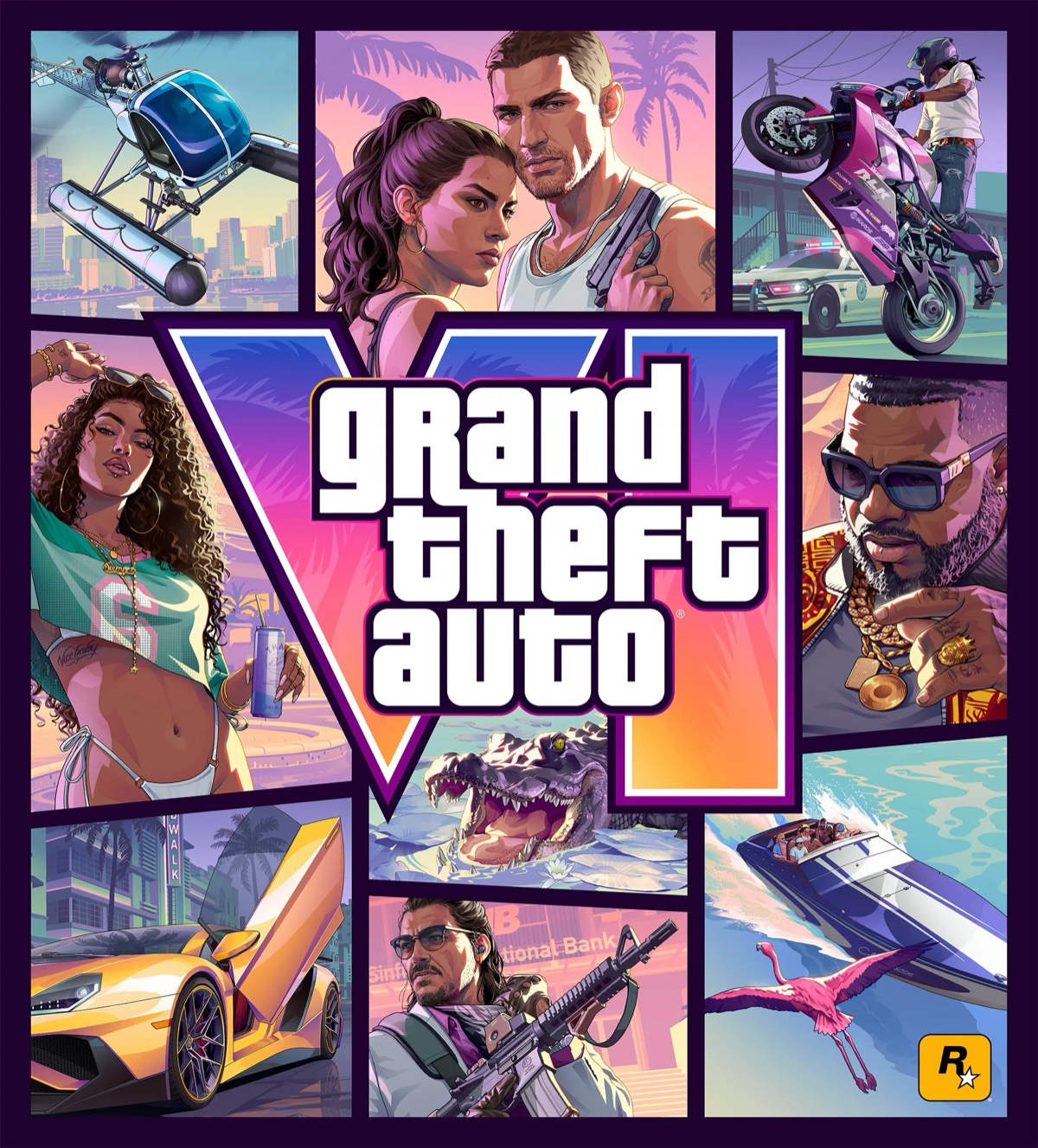
GTA 6's Cover Art Is Beautiful. June 25 Is About Something Else.
Rockstar revealed the official GTA 6 cover art on June 18, and it's a confident piece of franchise mythology. But pre-orders opening June 25 carry a question bigger than bonus content: is this the moment gaming crosses the $100 line?
 Gaming
I Hadn't Touched Spider-Man in Years, Then Spider-Man 2 Yanked Me Off the Roof
I came back to web-swinging after a long break, expecting to bounce off it. Instead I lost a whole weekend gliding over Marvel's New York and grinning like an idiot.