
Battlefield 6 Sold 7 Million Copies in 3 Days. EA Laid Off Its Developers Anyway.
The Best-Selling Game of 2025 Just Fired Its Own Creators
Here is a sentence that should not make sense: EA laid off an undisclosed number of employees across all four studios behind Battlefield 6 -- the best-selling premium game of 2025 in the United States, a title that moved 7 million copies in its first three days and peaked at 747,440 concurrent players on Steam.
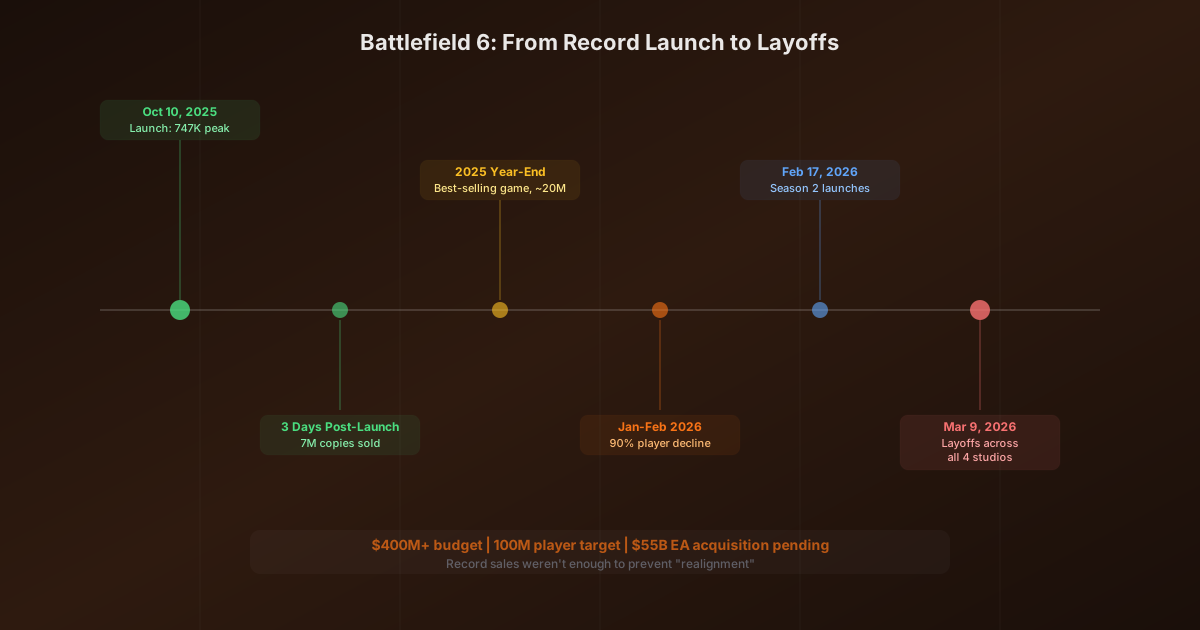
But it happened. On March 9, 2026, reports confirmed that EA had cut staff at DICE, Criterion, Ripple Effect, and Motive -- the four studios that collectively form Battlefield Studios and spent years building what EA itself called "the biggest launch in franchise history." All four studios remain open and will continue supporting the game's live-service seasons, but the people who shipped it are already being shown the door.
EA's official statement could have been generated by a corporate euphemism algorithm: "We've made select changes within our Battlefield organization to better align our teams around what matters most to our community." The company added that Battlefield "remains one of our biggest priorities" and that it is "continuing to invest in the franchise, guided by player feedback and insights from Battlefield Labs."
Translation: the game made a lot of money, but not enough to justify how much it cost to make, how many people it took to make it, and how quickly its players left.
By the Numbers: A Record Launch That Wasn't Enough
Battlefield 6's launch stats are objectively impressive. Released on October 10, 2025 for PS5, Xbox Series X/S, and PC, the game posted numbers that any publisher would celebrate:
- 7 million copies sold in the first three days
- An estimated $350 million+ in gross revenue in the first few days, according to analyst projections
- 747,440 peak concurrent players on Steam -- making it the second most-played game on the platform behind Counter-Strike 2
- 172 million matches played in the first three days
- 15 million hours watched on streaming platforms
- Best-selling premium game of 2025 in the US according to Circana data, finishing well ahead of Call of Duty: Black Ops 7 (which placed fifth)
- An estimated 20 million total units sold by year's end
EA's Q3 2026 earnings reflected the impact: net bookings jumped 38% year-over-year to $3.046 billion. By any reasonable measure, Battlefield 6 was a commercial hit.
The problem is that EA's measure was not reasonable.
The Impossible Target: 100 Million Players
According to reporting from Ars Technica, EA internally set a target of 100 million players for Battlefield 6. One hundred million. To put that in perspective:
- Battlefield 1, the previous most successful entry in the franchise, reached approximately 30 million unique players (including free trials and EA Access) over its lifetime
- Overwatch 2 had about 35 million players in its first month
- Fortnite took years to build its 400+ million account base
Developers at DICE reportedly told Ars Technica that the 100 million target seemed "unreasonable and near impossible" from the start. They were right. Even with a massive launch and a free-to-play battle royale mode called RedSec (released October 28, 2025 to broaden the player base), hitting triple-digit millions was never realistic for a franchise whose all-time best had reached 30 million.
But that target shaped every decision. The $400 million development budget. The four-studio collaboration. The aggressive live-service roadmap. And ultimately, when the player base started shrinking instead of growing toward 100 million, it shaped the decision to cut jobs.
The 90% Decline Nobody Talks About
The launch was a peak. Everything since has been a slope pointing down.
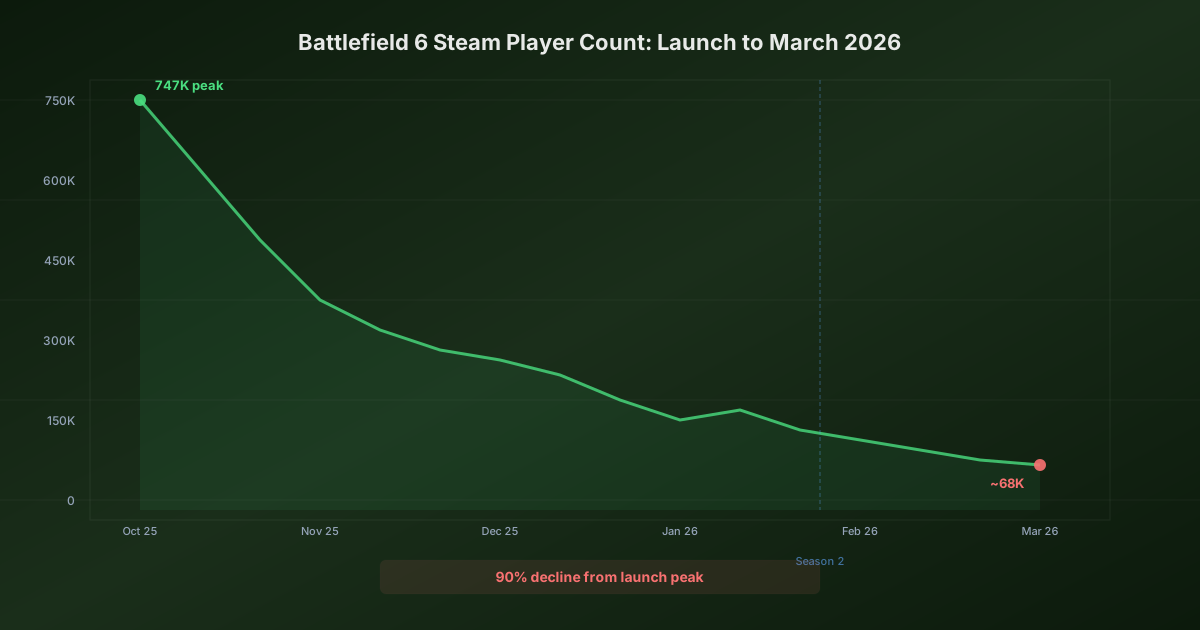
Here is what the Steam player count trajectory looks like:
- October 2025 (launch): 747,440 peak concurrent
- December 2025: Peaks around 190,000
- January 2026: Daily peaks of 70,000-80,000
- February 2026 (Season 2): Brief bump, settling back to 50,000-70,000
- March 2026: Peaks around 68,000
That is a decline of more than 90% from launch peak in under five months. The SteamDB data is stark: a game that was the second most-played title on Steam in October is now averaging a fraction of its launch population.
Multiple factors drove the exodus. Players have complained about aggressive monetization in what is already a $70 premium title (sound familiar?), lack of persistent servers, netcode issues, and updates that introduced new bugs. The competition has also stiffened -- Arc Raiders recently surpassed Battlefield 6 in daily concurrent Steam users, an embarrassing benchmark for a franchise with this kind of investment behind it.
Season 2 launched on February 17 with a new map called "Contaminated," the returning AH-6 Little Bird helicopter, new weapons, and a VL-7 psychoactive smoke mechanic. It produced a temporary uptick in players but failed to reverse the broader decline. The season introduced three new weapons, two new gadgets, and multiple limited-time modes, but the core issues driving players away -- monetization, technical instability, and a live-service structure that many feel is too thin -- remain largely unaddressed.
$400 Million and Four Studios
Battlefield 6's development cost is reported at over $400 million, making it one of the most expensive video games ever produced. For context, that is roughly equivalent to the budgets of major Hollywood blockbusters like Star Wars: The Force Awakens or Jurassic World: Fallen Kingdom.
That money funded a development effort spanning four studios across multiple countries and time zones. DICE (Stockholm) led development as the series creator. Criterion (Guildford, UK) contributed after pivoting from Need for Speed. Ripple Effect (Los Angeles) handled multiplayer components. Motive (Montreal) worked on single-player and additional content. A fifth studio, Ridgeline Games, also contributed before being shut down by EA in 2024.
The multi-studio approach was supposed to be Battlefield's advantage -- more hands, more content, faster iteration. Instead, reports suggest it created cultural clashes between studios with different working styles, coordination overhead that slowed decision-making, and burnout that reportedly led to some developers taking up to nine months off during the project's protracted development.
Now those same studios are shedding staff. The exact number of affected employees has not been disclosed, but the cuts span all four remaining teams. The layoffs are being described as a "realignment" -- a word that means the same thing in every industry: someone at the top decided the team is too large for the revenue the product is generating.
The $55 Billion Shadow
These layoffs do not exist in isolation. EA is in the process of being acquired for $55 billion by a consortium led by Saudi Arabia's Public Investment Fund (PIF), Silver Lake Partners, and Jared Kushner's Affinity Partners. Shareholders approved the deal in December 2025. It is expected to close by June 2026.
The deal values EA at $210 per share -- a 25% premium -- and will take the company private. PIF will hold the largest stake at 93.4%, with Silver Lake at 5.5% and Affinity Partners at 1.1%. The transaction is being funded by roughly $36 billion in equity and $20 billion in debt financing from JPMorgan Chase.
EA has stated that the Battlefield layoffs are unrelated to the pending acquisition, and that CEO Andrew Wilson will remain in charge with the company headquartered in Redwood City. Whether you believe that depends on how much you trust corporate statements made during a $55 billion leverage buyout. Companies going private under new ownership routinely restructure workforces. The timing may be coincidental. It may also be a preview.
What is clear is that Battlefield 6's economics are under scrutiny. A $400 million development budget needs sustained revenue to justify itself, and a live-service game losing 90% of its player base in five months is not generating the ongoing engagement that makes those numbers work. Under new ownership with $20 billion in debt to service, the pressure on every EA studio to demonstrate profitability will only increase.
What This Tells Us About the Industry in 2026
Battlefield 6's story is the gaming industry's central contradiction distilled into a single product: a game can be the best-selling title of the year and still be considered a failure by its publisher.
Seven million copies in three days. Best-selling game in America. Almost 750,000 concurrent Steam players. And it was not enough, because the target was 100 million players, the budget was $400 million, and the player base started evaporating before the first season was over.
This is the live-service trap. The business model does not just need a good launch -- it needs sustained engagement, recurring spending, and a growing player base month after month. When you spend $400 million building the product and set a target of 100 million players, even 20 million copies sold and best-in-class launch numbers become a disappointment.
The pattern is becoming depressingly familiar. Concord launched and shut down in two weeks. Hyenas was cancelled before it shipped. Anthem was abandoned after launch. And now Battlefield 6 -- which actually succeeded commercially -- is shedding the people who built it because "success" was not enough to meet the projections that justified the budget.
The people being laid off are not responsible for the 100 million player target. They are not responsible for the $400 million budget. They shipped a game that outsold Call of Duty. And they are the ones paying the price for goals that their own developers said were unreasonable from the start.
Battlefield 6 the game is fine. Battlefield 6 the business is the problem. And the four studios that poured years of their lives into building it are learning, again, that being the best-selling game of the year does not protect you from a spreadsheet.
Sources
- Battlefield 6 Studios Reportedly Hit With Layoffs -- Kotaku
- Record Breaking Battlefield 6 Sales Not Enough to Prevent Layoffs -- Push Square
- EA Laid Off Staffers Across Battlefield Studios -- Engadget
- Battlefield 6's Quartet of Studios Hit With Layoffs -- PCGamesN
- Battlefield Studios Hit With Layoffs -- Game Informer
- Battlefield 6 Devs Hit With Layoffs After 20 Million Units Sold -- GamesRadar+
- Battlefield 6 Shatters Records -- EA Investor Relations
- Battlefield 6 Player Count Down 90% From Peak -- Game Rant
- Battlefield 6 Player Count Falls From 750K to 30K-90K -- NotebookCheck
- EA Reportedly Expects 100 Million Players -- PC Gamer
- Battlefield 6 Reportedly Has $400M+ Budget -- Kotaku
- EA Acquisition by PIF, Silver Lake, and Affinity Partners -- EA Investor Relations
- EA Buyout Approved by Shareholders -- Variety
- Battlefield 6 Season 2 Roadmap -- EA

Founder of GGS Blog and Site Reliability Engineer at Box. I write about gaming, AI in gaming, and game development with a technical lens — 10+ years in software engineering, 20+ years as a gamer. My work focuses on what the tech actually means for players.
Never miss a post
Subscribe to the GGS Blog newsletter for gaming news, tech insights, and AI in the game industry — delivered straight to your inbox.
Free. No spam. Unsubscribe in one click.
Comments
What to Read Next
Continue exploring our coverage of gaming, technology, and AI.
 Industry News
GTA 6: The Forums Say 20 Minutes. The Market Says Don't Bet on 30.
Polymarket traders and Reddit threads are measuring the same GTA 6 audience and returning different readings. Ahead of the August 27 Netflix showcase, here's what each instrument actually sees, why the $1.39 billion everyone is quoting is the wrong number, and why I can't tell you which reading to trust.
 Industry News
Arc Raiders Lost 80% of Its Steam Players. It's Still One of 2026's Biggest Games.
Arc Raiders' Steam concurrent count has cratered and recent reviews flipped to Mixed — but the game has sold 16 million copies and Embark is still patching it every two weeks. The scary chart isn't the real story. The content gap might be.
 Industry News
PlayStation's 'The Playerbase' Wants to Put You Inside Gran Turismo 7 — Read the Fine Print First
Sony just launched a fan-integration program that scans one winner into Gran Turismo 7 with a custom logo and livery. The headline is flattery; the licensing terms are forever. Here's what's happening underneath, what it costs you, and why PlayStation is doing it now.