
Tencent Unveils VISVISE AI Suite at GDC 2026: From Days to Minutes
Tencent Brought an Entire AI Factory to San Francisco
GDC 2026 had no shortage of companies waving the AI flag. But Tencent Games walked into the Moscone Center with something different: not a single flashy demo or a vague promise about "the future of content creation," but an interconnected suite of production tools that their own studios have already been using on shipped titles.
Across booths #641 and #649 in South Hall B1, from March 11-13, Tencent showcased VISVISE (their AI-powered creation suite), MagicDawn (an engine technology layer that works with Unreal, Unity, and Godot), ASI World (an automated production pipeline), and a series of AI motion and companion systems from MoreFun Studios. They also ran more than 20 sessions across the conference, including a Luminaries Speaker Series appearance by Nathan Chen, Tencent Games' Head of Technology.
This wasn't a research lab presentation. This was a company saying: we built these tools, we're using them in production right now, and here's what they do.
VISVISE: The Full-Stack AI Animation and Modeling Suite
VISVISE — "Vision Gets Wise" — is the centerpiece of Tencent's AI game development push. It first appeared at Gamescom 2025, but GDC 2026 marks its proper global debut with live, hands-on demonstrations.
The suite covers two major production pipelines: animation and 3D modeling. Both are built on proprietary foundation models, and both target the same problem — the parts of game art production that are technically demanding, repetitive, and brutally time-consuming.
Animation: MotionGen Foundation Model
The animation pipeline runs on MotionGen, which Tencent describes as "the industry's first deployable multimodal motion generation large model." Stripped of the marketing language, here's what it does:
- 3D animation generation from multimodal inputs (text prompts, reference video, keyframe direction)
- Auto-rigging that takes character models from static meshes to fully rigged, animation-ready assets
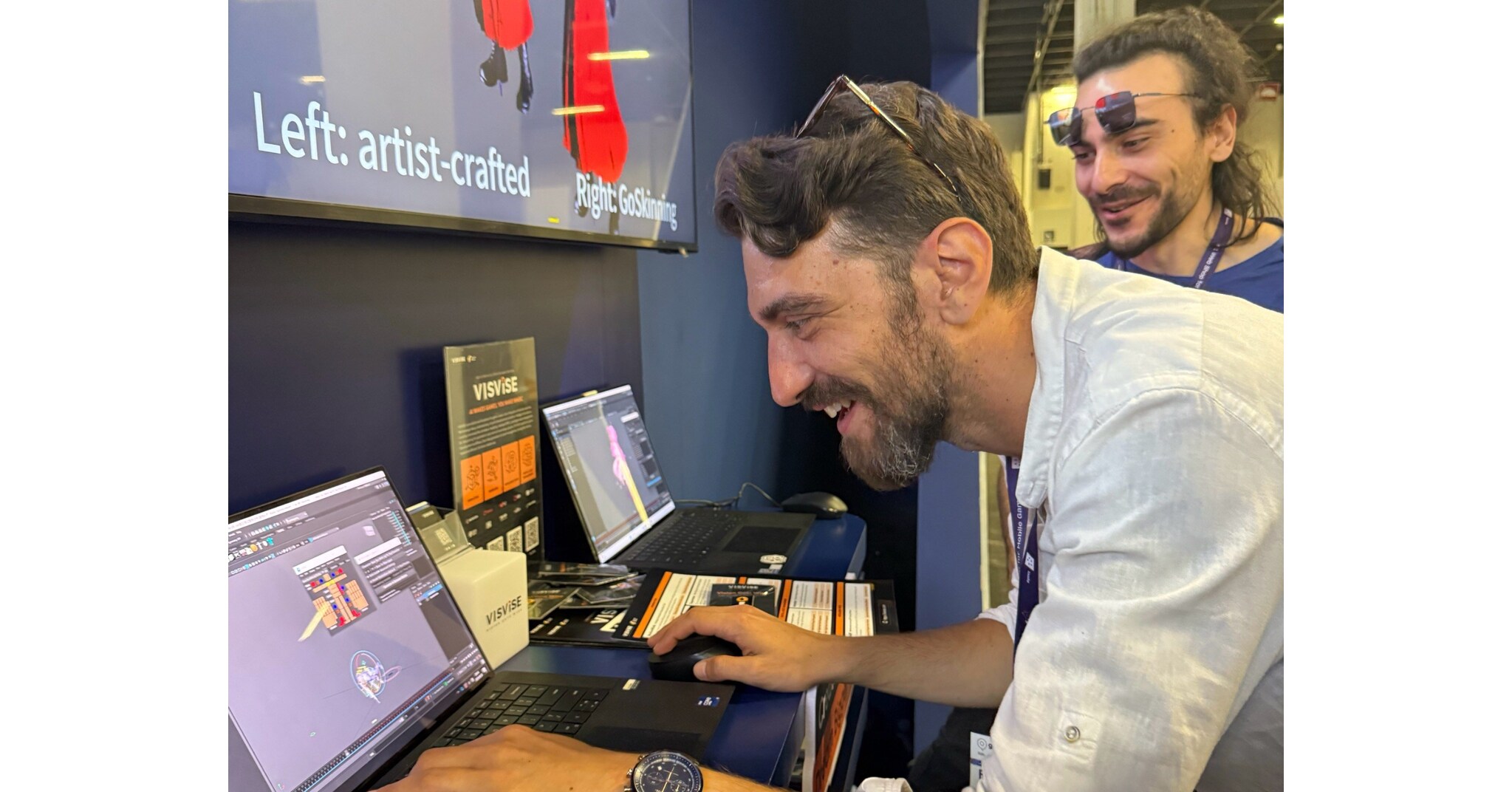
- Auto-skinning via their GoSkinning system, achieving over 90% weight accuracy with an approximately 85% automation rate
- Motion in-betweening (MIB) that generates up to 200 frames in just 4 seconds
The auto-skinning numbers are the most striking here. Character skinning — the process of defining how a mesh deforms around a skeleton — is one of those tasks that experienced technical artists spend days doing manually. Tencent claims their system reduces that from roughly 3.5 days to minutes. The GoSkinning system uses a two-step process of bone chain prediction and weight refinement, with a proprietary "Skirt AI" specifically designed for complex garment deformations (an area where automated skinning traditionally falls apart).
The MIB module deserves attention too. Motion in-betweening fills in the frames between keyframes — the bread and butter of animation. Generating 200 frames in 4 seconds, with quality that Tencent claims "rivals motion capture," would fundamentally change how animation teams budget their time.
3D Modeling: MeshGen-O Foundation Model
The modeling side is built on MeshGen-O, enabling topology-level 3D mesh generation. The headline number: 3-4x faster production speeds compared to traditional workflows.
More usefully, the system includes:
- Auto-Retopologization — automatically cleaning up mesh topology for production use
- Intelligent LOD generation — producing up to six Level of Detail variants automatically, optimized for both PC and mobile platforms
- Cross-platform asset delivery built into the pipeline from the start
The LOD generation is particularly practical. Manually creating LOD variants is one of those tasks that everyone knows is necessary and nobody enjoys doing. Having the system automatically generate six LOD levels that meet cross-platform requirements removes a significant chunk of busy work from the asset pipeline.
Already in Production
VISVISE isn't vaporware. Its GoSkinning system alone has been implemented in the development of more than 90 games, and VISVISE's broader toolset has been adopted for titles including PUBG Mobile and Wuthering Waves. Cheng Ge, Director of AIGC Product R&D at Tencent Games, presented a session titled "Unleash Artistic Creativity: How Tencent's AIGC Tools Equip Creators," walking through real-world applications in the 3D character production pipeline.
The messaging from Tencent is deliberate: these tools automate repetitive tasks with human oversight, not replace creative decisions. Whether you believe that framing is entirely up to you, but the fact that these tools have been deployed across dozens of production titles gives them credibility that many AI tool announcements lack.
MagicDawn: AAA Lighting for Every Engine
If VISVISE handles the asset creation side, MagicDawn handles how those assets look once they're in the game. It's an AI-driven engine technology layer focused on three pillars: global illumination, spatial audio, and occlusion culling.
The most notable thing about MagicDawn isn't any single feature — it's the engine compatibility. MagicDawn integrates with Unreal Engine, Unity, and Godot. That Godot inclusion matters. While UE and Unity support is table stakes for any serious middleware, adding first-class Godot support signals that Tencent is paying attention to where indie and mid-tier development is heading.
Global Illumination
MagicDawn's GI system combines several approaches:
- Neural-rendering dynamic GI — described as the industry's first implementation for high-quality dynamic lighting with minimal package size impact
- PRT-based solution (Precomputed Radiance Transfer) supporting both Probes and Lightmaps
- Cascade Lighting Volume (CLV) for Time of Day transitions
- Cloud-rendering SaaS for lighting bake workflows, claiming up to 40x efficiency improvement in targeted scenarios
That 40x number for cloud-rendered lighting workflows is impressive if it holds up in practice. Lighting bakes are one of the biggest bottlenecks in environment art — a single change to a scene can trigger hours of rebaking. If cloud-accelerated workflows can cut that meaningfully, it changes how teams iterate on level design.
Spatial Audio
The spatial audio system supports static, semi-dynamic, and fully dynamic scenes, with cross-engine compatibility. One demo attendee noted that "the improvement in directionality and situational awareness" was immediately noticeable "without making the workflow feel heavier" — a relevant concern for any middleware that promises to improve audio quality.
Academic Foundation
MagicDawn isn't just a product announcement — it's backed by published research. The team has papers at SIGGRAPH 2025 ("Gaussian Compression for Precomputed Indirect Illumination"), CVPR 2026 ("Neural Dynamic GI"), and EUROGRAPHICS ("Lightmap Compression with Color-Coherent UV Clustering and Cascade Texture Optimization"). This academic track record, combined with their SIGGRAPH Asia 2025 technical presentation, suggests a system built on serious rendering research rather than hastily assembled AI features.
ASI World: An AI Pipeline That Builds Entire Games
ASI World — Artificial Super Intelligence World — is the most ambitious and potentially most controversial tool Tencent showed. It's an integrated AI content production pipeline that breaks game development into modular stages: narrative, scene design, and asset production.
The headline claim: ASI World can generate a complete SRPG game end-to-end from a single prompt over an extended session.
That's a bold statement. Strategy RPGs require interconnected systems — character progression, tactical combat, map design, narrative branching, dialogue trees, balance tuning. Generating all of that from a prompt raises obvious questions about quality, originality, and the gap between "technically functional" and "actually good."
But the real use case probably isn't "generate an entire game and ship it." It's rapid prototyping and pre-production. If a design team can describe a game concept and get a playable prototype in hours instead of weeks, that fundamentally changes how early-stage development works. Ideas that would never survive the pitch phase because they're too risky to prototype can now be tested cheaply.
Whether ASI World's output is closer to "rough prototype useful for iteration" or "generic AI slop" will depend on how much creative control developers retain in the process. Tencent hasn't shown enough of the system's actual output to make that judgment yet.
MoreFun Studios: AI Kung Fu and Natural Language Companions
Elvis Liu, Head of AI at MoreFun Studios (a Tencent subsidiary), ran a series of demonstrations that were arguably the most visually compelling part of the showcase.
AI-Generated Kung Fu Motion Systems
The Kung Fu motion system dynamically generates martial arts animation sequences — fluid, high-fidelity movements created by AI rather than motion capture or hand animation. For fighting games, action games, or any title with melee combat, this kind of technology could drastically reduce the cost and time required to build combat animation libraries.
Traditional motion capture for martial arts is expensive. You need performers, a mo-cap studio, cleanup artists, and significant post-processing time. If AI-generated motion can approach the quality of captured performance data, it opens up complex combat animation to studios that can't afford dedicated mo-cap facilities.
AI Companions
MoreFun also demonstrated AI companions that understand and respond to natural language, enabling more dynamic player interactions. This sits in the same territory as other NPC AI efforts across the industry, but seeing it demonstrated alongside the motion systems suggests Tencent is thinking about these as interconnected tools rather than isolated features.
TiMi Studio Group: Honor of Kings at Scale
Leon Zhang and Zhipeng Tan from TiMi Studio Group presented "The Scalable Game Asset-Assisted Production Pipeline of Honor of Kings" at the Machine Learning Summit. Honor of Kings — the highest-grossing mobile game in the world, consistently — serves as a proving ground for AI-assisted asset production at massive scale.
The session focused on how AI-enhanced workflows enable high-efficiency production in large-scale live-service environments. For a game that regularly ships new heroes, skins, events, and map updates, any percentage improvement in asset pipeline efficiency translates directly to meaningful time and cost savings.
This is where Tencent's AI tools stop being theoretical and become practical. They aren't just building these tools and hoping someone uses them — they're deploying them in one of the most demanding production environments in the industry.
The Bigger Picture: How Tencent Compares to the Competition
Tencent isn't the only company building AI game development tools. The AI 3D asset market is projected to grow from $1.89 billion in 2024 to $7.21 billion by 2029 at a 30.7% compound annual growth rate, according to The Business Research Company. The field is getting crowded fast.
Meshy, a 3D generative AI company, highlighted at GDC that "what once took weeks and cost $1,000 now takes just two minutes and $1." Tripo AI launched Tripo P1.0, a production-ready 3D model generation system, claiming nearly 100 million 3D models generated since founding. NetEase Games delivered five talks covering pipeline updates for open-world and mobile art production.
What sets Tencent apart is the breadth of their approach. Most AI game dev companies are building point solutions — a 3D model generator here, an animation tool there. Tencent is building an integrated ecosystem: VISVISE for creation, MagicDawn for rendering, ASI World for pipeline automation, WeTest for QA (serving over 1,000 game companies), and ACE for anti-cheat. These tools talk to each other.
That ecosystem approach has trade-offs. Integration means vendor lock-in. Tencent-built tools optimized for Tencent-scale production may not translate perfectly to a 5-person indie team. And there's a reasonable argument that best-of-breed point solutions, picked for your specific needs, serve most studios better than an all-in-one suite.
But for mid-to-large studios producing content at scale, the appeal of a unified AI pipeline is obvious.
What This Means for Developers
Three takeaways from Tencent's GDC 2026 showing:
The automation floor is rising. Tasks that defined junior-to-mid technical art roles — skinning, rigging, LOD creation, lighting bakes — are being automated at production quality. This doesn't mean those roles vanish overnight, but it means the skills that make someone valuable are shifting toward creative direction, quality assessment, and understanding how to guide AI tools effectively.
Engine agnosticism is the future of middleware. MagicDawn supporting UE, Unity, and Godot reflects a market reality: no single engine dominates every segment anymore. Tool makers that only support Unreal are leaving money on the table.
The prototype-to-production gap is shrinking. Between ASI World's game-from-a-prompt capability and VISVISE's rapid asset generation, the time between "we have an idea" and "we have a playable build" is compressing dramatically. That's good for experimentation and bad for studios whose competitive advantage was simply "we can execute faster than you."
Tencent's AI tools won't matter to every developer. A solo dev hand-crafting pixel art doesn't need auto-rigging. But for studios producing 3D content at any meaningful scale, the tools demonstrated at GDC 2026 represent a genuine shift in what's possible — and what will soon be expected.
Sources
- Tencent Games Showcases Tech Advancements Shaping Future Player Experience at GDC 2026 — PR Newswire
- Tencent Games unveils AI tools and developer sessions for GDC 2026 — Inven Global
- Tencent Games' VISVISE Makes Its GDC Debut, Showcasing Full-Stack AI Animation and Modeling Solutions — Games Press
- Tencent Games Debuts MagicDawn at GDC 2026, Showcasing AI-Driven Global Illumination and Spatial Audio — Games Press
- Tencent debuts new AI tool to automate art production — Game Developer
- Tencent Games Highlights AI, Engine Tech, Player Safety Tools at GDC 2026 — TechBeatph
- Game companies harness power of AI — China Daily

Founder of GGS Blog and Site Reliability Engineer at Box. I write about gaming, AI in gaming, and game development with a technical lens — 10+ years in software engineering, 20+ years as a gamer. My work focuses on what the tech actually means for players.
Never miss a post
Subscribe to the GGS Blog newsletter for gaming news, tech insights, and AI in the game industry — delivered straight to your inbox.
Free. No spam. Unsubscribe in one click.
Comments
What to Read Next
Continue exploring our coverage of gaming, technology, and AI.
 Game Development
Can a Solo Dev Ship an iOS Game in 2026 Using Only AI Tools? (Build Log, Day 0)
Day 0 of a build log: I'm going to attempt to ship an iOS game to the App Store in 2026 using AI tools for as much of the work as possible. Today is reconnaissance — what AI can actually do, what it can't touch, and three falsifiable predictions for the next checkpoint.
 Game Development
The Jobs Don't Come Back: What It Means to Be a Game Developer in 2026
Over 45,000 gaming jobs have been cut since 2022, and 55% of those laid off still haven't found new work. The Skillsearch 2026 report puts human numbers to a crisis that studios are now describing as permanent — and the people who built the games you love are the ones paying for it.
 Game Development
What Does a $200 Million Game Have to Sell to Break Even?
Three AAA live-service launches in April 2026 — Pokémon Champions, Crimson Desert, and Marathon — are testing whether the industry's standard playbook for recovering from a rough launch can actually work at this scale.