
AI in Gaming 2026: From Grunt Work and Smart Monitors to a $2 Billion AGI Bet
The Gap Between the AI Headlines and the AI Reality
There is a version of 2026 where AI has already revolutionized gaming. In that version, procedurally generated worlds write themselves, NPCs hold philosophical debates with players, and studios ship AAA titles with skeleton crews powered by generative tools. If you read enough press releases, you might think we are living in that version.
We are not.
What is actually happening is more interesting and far messier. The GDC 2026 State of the Game Industry survey just dropped data from over 2,300 developers, and the picture it paints is one of an industry that has adopted AI enthusiastically for the boring stuff while remaining deeply skeptical about using it for anything creative. At the same time, hardware makers at CES 2026 pushed AI into places nobody asked for -- like monitors that zoom into your health bar -- and a Chinese gaming billionaire is betting $2 billion that he can build artificial general intelligence before the decade is out.
This is the real state of AI in gaming right now. Not a single story, but five overlapping ones that together reveal where this industry is actually headed.
Beyond the Hype: Studios Use AI for Grunt Work, Not Creativity
The GDC 2026 State of the Game Industry report is the closest thing this industry has to a census. This year's edition surveyed 2,300+ professionals, and the generative AI section tells a story that no one at an AI startup wants to hear.
36% of game industry professionals are actively using generative AI tools at work. That number sounds significant until you look at what they are using it for:
- 81% use it for research and brainstorming
- 47% use it for writing emails and administrative tasks
- 47% use it for code assistance
- 35% use it for prototyping
Now look at the creative applications -- the ones that dominate AI marketing materials:
- 19% use it for asset generation
- 10% for procedural content generation
- 5% for player-facing features
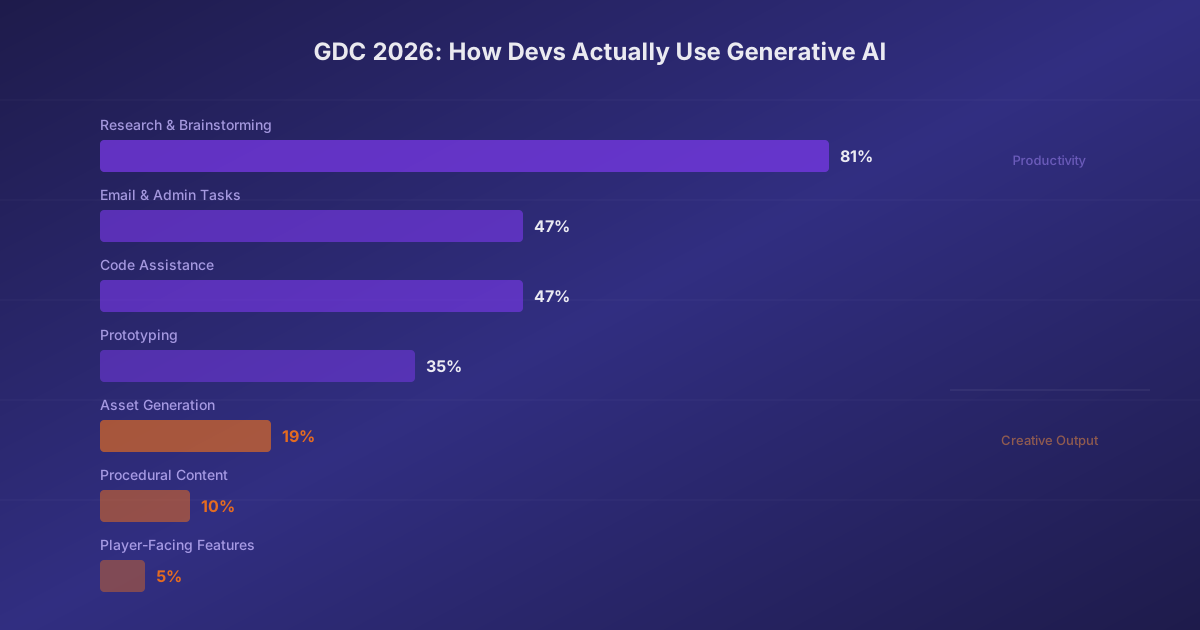
Read that again. Only 5% of developers are using generative AI for anything players actually see. The overwhelming majority are using it as a glorified research assistant and email writer. ChatGPT (used by 74% of those who use AI tools) and Gemini (37%) are the dominant tools -- not Midjourney, not Stable Diffusion, not any of the purpose-built game asset generators that have received hundreds of millions in venture funding.
The sentiment data is equally revealing. 52% of industry professionals now say generative AI is negatively impacting the games industry, up from 30% in 2025 and just 18% in 2024. That is a tripling of negative sentiment in two years. The skepticism is strongest among the people who would theoretically benefit most from AI creative tools: 64% of visual and technical artists, 63% of game designers and narrative developers, and 59% of programmers hold unfavorable views.
One anonymous developer captured the tension perfectly in the survey: "AI is theft. I have to use it, otherwise I'm going to get fired."
There is also a hierarchy gap worth noting. Upper management uses AI tools at a 47% rate, while lower-level employees sit at 29%. Studios are increasingly building proprietary AI systems -- roughly 30% of AAA studios now use internal tools trained on their own data -- which suggests the industry is bifurcating between companies that treat AI as a productivity multiplier and those that see it as a threat to creative integrity.
The takeaway is not that AI is failing in gaming. It is succeeding wildly -- at tasks nobody writes breathless headlines about. Studios are shipping games faster because their producers use AI to draft schedules, their programmers use it to debug code, and their designers use it to brainstorm mechanics. The revolution is real. It is just boring.
CES 2026: When Your Hardware Gets an AI Brain
While GDC showed us how developers feel about AI, CES 2026 showed us what hardware companies think gamers should feel about it. The answer, apparently, is "grateful that your GPU and monitor are doing so much of the work for you."
NVIDIA DLSS 4.5: Most of Your Frames Are Now Imaginary
NVIDIA announced DLSS 4.5 at CES 2026, and the headline feature is 6X Dynamic Multi Frame Generation. Here is what that means in plain terms: for every single frame your GPU actually renders the traditional way, DLSS 4.5 can generate up to five additional AI-predicted frames and insert them into the output. Your display shows six frames, but only one of them is "real."
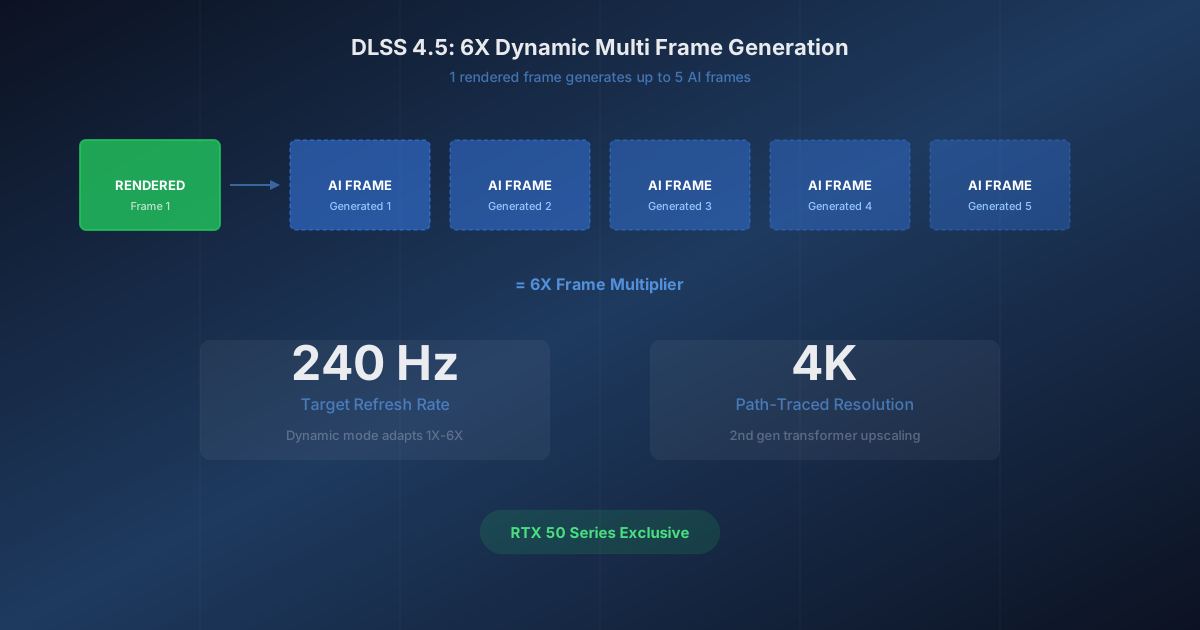
The target scenario is 4K path-traced gaming at 240+ FPS on RTX 50 series GPUs. DLSS 4.5 also introduces a second-generation transformer model for Super Resolution that improves upscaling quality across all RTX GPUs, and a Dynamic mode that automatically adjusts the frame multiplier between 1X and 6X to match your monitor's refresh rate.
The technology is genuinely impressive. It is also philosophically strange. At 6X, you are looking at a screen where 83% of what you see was hallucinated by a neural network. NVIDIA would argue (correctly) that the result looks great and feels smooth. Critics would argue (also correctly) that there is something odd about a "240 FPS gaming experience" where your GPU only rendered 40 of those frames. The other 200 are the AI's best guess about what should have happened between the real ones.
For competitive gaming, this raises questions that do not have clean answers yet. Frame generation adds latency -- even a few milliseconds -- and fighting game players or CS2 professionals will want to know exactly how much. NVIDIA's dynamic mode helps here by scaling back the multiplier when latency matters more than frame count, but the tension between "beautiful" and "responsive" is baked into the technology.
DLSS 4.5 Super Resolution is available now for all RTX owners through an NVIDIA app update. The 6X Multi Frame Generation mode arrives in spring 2026 as an RTX 50 series exclusive.
Lenovo's AI Gaming Display: When Your Monitor Is the Aimbot
If NVIDIA is generating fake frames, Lenovo went a step further at CES 2026 by building a monitor that actively interprets and modifies what you see. The AI Frame Gaming Display is a proof-of-concept monitor with built-in AI that does things monitors have never done before:
- AI Scene Detection identifies the game you are playing and intelligently zooms into key areas, displaying them in a picture-in-picture window in the top-right corner. Playing an FPS? It can magnify the minimap. In a MOBA? It can zoom on your ability cooldowns.
- Cursor Tracking follows your mouse cursor and displays a zoomed view of the area around it, effectively giving you a built-in magnification tool.
- Adaptive AI Lighting adjusts ambient backlighting based on in-game events -- the screen border might flash red when you take damage, for example.
This is where accessibility and competitive advantage start to blur. A monitor that automatically zooms into your health bar when it drops low is genuinely useful for players with visual impairments. A monitor that magnifies enemy positions at long range starts to feel like hardware-level aim assist. And a monitor that highlights important HUD elements based on AI scene recognition could easily provide competitive advantages in ranked play that no anti-cheat software is designed to detect.
Lenovo positioned this as a "proof of concept," which is corporate for "we want to gauge the reaction before committing." The reaction should be complicated, because the technology is.
AI Is Going to Make Cheating Different, Not Just Easier
The Lenovo display is a preview of a broader problem: as AI gets embedded into gaming hardware and software at every level, the line between "feature" and "cheat" gets harder to draw.
The most concrete example already played out in Arc Raiders. After Embark Studios' extraction shooter launched, PC players discovered they could use NVIDIA's built-in game filters to crank up brightness and contrast, turning pitch-black night raids into something closer to a cloudy afternoon. In a game where visibility is a core gameplay mechanic -- where night raids are supposed to be terrifying and disorienting -- this was devastating. Players with the right GPU settings could see clear across maps that were designed to be navigated by sound and flashlight.

The community response was immediate and furious. As one player put it: "The devs need to fix this or this game will die." Embark eventually got NVIDIA to add Arc Raiders to its unsupported list, so pressing Alt+F3 now shows a "supported game required" message. But players quickly found workarounds through console commands and .ini file modifications, creating a whack-a-mole situation that continues today.
What makes this different from traditional cheating is that the original exploit used NVIDIA's own officially-supported software. It was not a third-party hack or an injected DLL. It was a feature that NVIDIA ships with every GPU, being used in a way that NVIDIA probably did not anticipate but certainly enabled. Easy Anti-Cheat, which Arc Raiders uses, scans for overlays injecting into the render pipeline -- and NVIDIA's filters do exactly that, they just happen to come from a "legitimate" source.
This is the template for AI-assisted cheating going forward. It will not always look like aimbots and wallhacks. It will look like "smart" monitors that highlight enemies, GPU-level filters that enhance visibility, AI upscaling that sharpens distant targets, and peripheral software that "assists" your aim. Each individual feature will have a legitimate use case. Each will also be exploitable. And the traditional anti-cheat approach of scanning for known cheat signatures will struggle with exploits that run on official hardware using official drivers.
The industry needs a new framework for thinking about this, and it needs one soon.
What AI Agents Actually Mean for Gameplay in the Next 5 Years
While the cheating conversation focuses on AI being used against game design, there is a parallel story about AI being used to fundamentally improve it. AI agents -- autonomous systems that can perceive, decide, and act within game environments -- are pushing beyond scripted NPC behavior toward something genuinely emergent.
The poster child is Sony's Gran Turismo Sophy, developed through a collaboration between Sony AI, Polyphony Digital, and Sony Interactive Entertainment. Sophy is a superhuman racing AI trained using a novel reinforcement learning algorithm called Quantile-Regression Soft Actor-Critic (QR-SAC). It does not follow racing lines programmed by developers. It learned to race by racing millions of times, developing tactics, strategies, and racing etiquette that emerged organically from the training process.
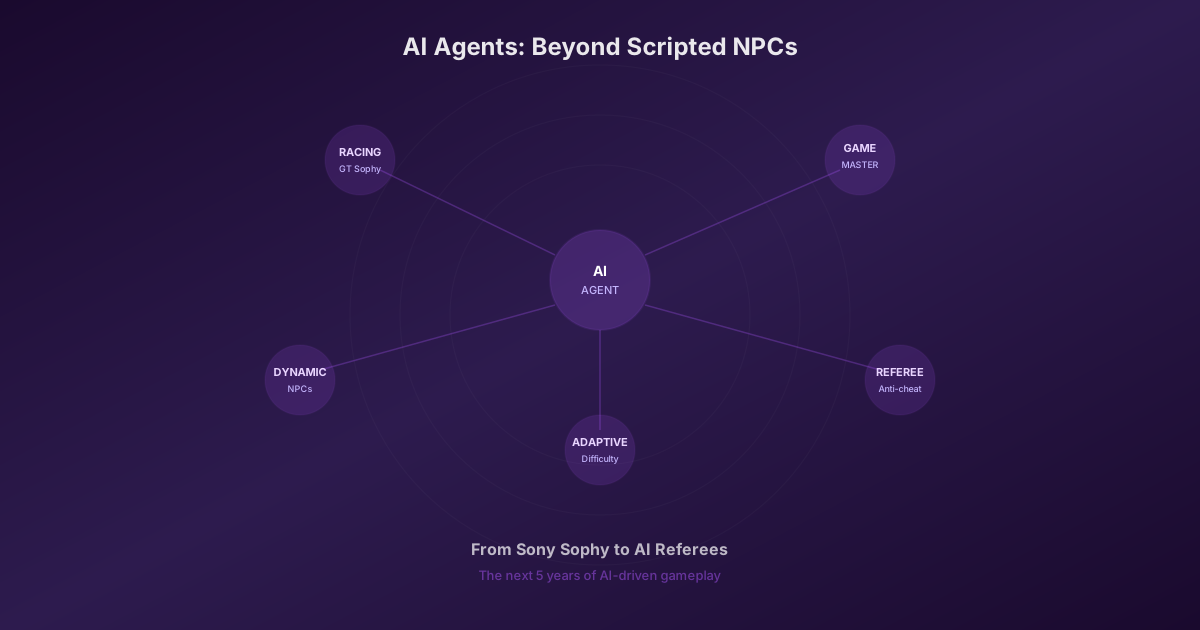
What makes Sophy significant is not just that it can beat the best human players -- superhuman game AI has existed since Deep Blue. It is that Sophy was trained to be fun to race against. Sony AI specifically tuned the system for sportsmanship, finesse, and temperament, creating an opponent that pushes you to improve without feeling cheap or robotic. Sophy 2.1, now available in Gran Turismo 7's Custom Race mode, lets players adjust the AI's behavior for a personalized experience.
Sony has been explicit that Sophy is "the first step to bring next-generation AI technology to agents in PlayStation gaming." The implication is clear: what works for racing opponents today will work for combat enemies, quest-giving NPCs, and open-world inhabitants tomorrow.
Beyond individual agents, the industry is exploring several AI roles that could reshape game design:
- AI as Game Master: Systems that dynamically adjust encounter difficulty, pacing, and narrative beats based on individual player behavior. Not the rubber-band difficulty of old, but genuine real-time game direction that responds to how engaged, frustrated, or bored a player seems.
- AI as Referee: Multiplayer games deploying machine learning to detect exploits, monitor balance issues, and adjust parameters in real time. Imagine an anti-cheat system that does not just ban known hacks but recognizes suspicious patterns of play and responds dynamically.
- AI as World Curator: Procedural content systems that use player behavior data to generate encounters, environments, and storylines tailored to individual play styles -- not generic randomization, but AI-directed experiences that feel authored.
The five-year outlook, based on current trajectories, includes voice-driven dynamic narratives where NPCs hold real conversations, emotional modulation systems that adjust game pacing based on player affect, and AI companions that learn individual player styles to provide personalized guidance. Whether any of this ships at scale in the next five years depends on whether studios can solve the cost, consistency, and quality control problems that still plague generative AI in production environments.
The GDC survey's 5% figure for player-facing AI features tells you where we are today. The research pipeline tells you where we are going. The gap between those two numbers is where the interesting work is happening.
When Game Money Chases AGI
And then there is Chen Tianqiao, who has decided the entire AI-in-gaming conversation is thinking too small.
Chen is China's original gaming billionaire. In the early 2000s, he built Shanda Interactive into one of the country's largest gaming empires, riding the success of Legend of Mir to become the richest person in China at age 31. At its peak, Shanda was a juggernaut -- 300 million RMB in annual net profit with just 100 employees. He later sold his gaming division and divested his web literature assets to Tencent, donated $115 million to Caltech for brain science research, and largely disappeared from public view.
Now he is back, and his ambition has scaled dramatically. According to Bloomberg reporting from March 5, 2026, Chen is committing approximately $2 billion toward building artificial general intelligence -- AI that matches or surpasses human cognitive abilities across domains. The project, which Bloomberg describes as targeting "discoverative AI," represents one of the largest individual bets on AGI outside the established players like OpenAI, Google DeepMind, and Anthropic.
The connection to gaming is not incidental. Chen's vision reportedly frames AGI as transformative for interactive entertainment and digital services by the end of the decade. The logic runs something like: if you can build an AI that truly understands and reasons about the world, you can build game worlds that think, adapt, and create in real time. No more scripted content. No more procedural generation that feels procedural. Just intelligence, applied to entertainment.
There are reasons to take this seriously. Chen has a track record of spotting paradigm shifts early -- he saw online gaming in China before most investors knew what broadband was. He has spent the last decade funding serious neuroscience research, not vanity AI projects. And $2 billion, while modest compared to the tens of billions flowing into frontier AI labs, is enough to attract world-class talent and make meaningful progress.
There are also reasons for skepticism. AGI remains a moving target with no consensus definition, let alone a clear engineering pathway. Every major AI lab in the world is working toward it, and none has achieved it. The claim that a gaming tycoon's private initiative will reach AGI before well-funded research organizations with thousands of PhD researchers strains credulity. The project is also reportedly based in China under strict PRC state oversight, which adds geopolitical complexity to an already difficult technical challenge.
The most honest assessment is probably this: Chen's bet matters less as an AGI moonshot and more as a signal. When someone who made billions in gaming decides the next fortune is in general intelligence, it confirms that the smartest money in the industry sees AI not as a feature to be added to games, but as the foundation on which the next generation of interactive entertainment will be built.
Whether that foundation arrives in five years, fifteen, or never is a separate question.
What All of This Means
Pull these five threads together and a picture emerges.
Right now, AI in gaming is mostly a productivity tool. Developers use it to write emails, brainstorm features, and debug code. The creative applications that dominate marketing materials account for a vanishingly small share of actual usage. The people closest to the creative work -- artists, designers, writers -- are the most skeptical.
In hardware, AI is being pushed into every layer of the rendering and display pipeline. NVIDIA is generating more frames than your GPU renders. Lenovo wants your monitor to interpret the game for you. Both are technically impressive and raise genuine questions about authenticity and fairness.
In the gray area, AI-powered exploits are blurring the line between features and cheats. The Arc Raiders night-vision controversy was a preview, not an outlier. As AI gets embedded deeper into hardware and drivers, the exploits it enables will get harder to detect and harder to classify.
On the horizon, AI agents are showing genuine promise for making games more dynamic, responsive, and personal. Sony's Sophy proves the concept works. The question is whether studios can scale it beyond showcase demos.
And in the background, billions of dollars are flowing into AI research from people who believe gaming is just the beginning. Chen Tianqiao's $2 billion AGI bet is extreme, but the direction is shared across the industry.
The common thread is a gap -- between what AI can do and what we are comfortable letting it do in games. That gap is where every interesting debate in this industry will happen for the next several years. The technology is moving fast. The frameworks for thinking about it have not caught up yet.
Stay critical. Stay curious. And maybe check whether your monitor is doing more than you think it is.
Sources
- GDC 2026 State of the Game Industry Report -- GDC
- GDC 2026 Report: Generative AI Impact -- GIANTY
- 2026 State of the Game Industry Press Release -- BusinessWire
- NVIDIA DLSS 4.5 with 6X Dynamic Multi Frame Generation -- NVIDIA
- NVIDIA DLSS 4.5 CES 2026 Announcements -- NVIDIA
- Lenovo Levels Up CES with Legion Gaming Devices -- Lenovo
- Lenovo AI Concepts at CES 2026 -- Lenovo
- Arc Raiders NVIDIA Filters Exploit -- Dexerto
- Arc Raiders NVIDIA Filters Disabled -- MyWinterCar Wiki
- Sony AI Gran Turismo Sophy -- Sony AI
- The Future of Game Intelligence -- COGconnected
- Chen Tianqiao $2B AGI Investment -- Bloomberg
- Chen Tianqiao and Shanda Group History -- Oreate AI

Founder of GGS Blog and Site Reliability Engineer at Box. I write about gaming, AI in gaming, and game development with a technical lens — 10+ years in software engineering, 20+ years as a gamer. My work focuses on what the tech actually means for players.
Never miss a post
Subscribe to the GGS Blog newsletter for gaming news, tech insights, and AI in the game industry — delivered straight to your inbox.
Free. No spam. Unsubscribe in one click.
Comments
What to Read Next
Continue exploring our coverage of gaming, technology, and AI.
 AI in Gaming
The Execution Layer: MCP Connectors Are Rewriting Who Can Use Game Dev Tools
Nine Claude connectors for Blender, Autodesk, and Adobe dropped in a single release. Meanwhile, community MCP servers have been executing natural-language commands inside Houdini, Maya, and Unreal for months. This isn't just automation — it's a fracture in what tool expertise actually means.
 AI in Gaming
Nexon Bets Big on AI With 'Mono Lake' Platform, Promises More Innovation and Less Code
Arc Raiders' publisher unveiled its end-to-end AI intelligence platform at a Tokyo briefing, claiming billions of player sessions will empower developers — not replace them. The GDC 2026 survey tells a different story about how developers feel.
 AI in Gaming
The AI Paradox: 52% of Game Developers Say AI Is Harmful — While 52% of Studios Adopt It Anyway
The GDC 2026 State of the Industry survey revealed a perfect paradox: developer opposition and corporate adoption have hit the exact same number. Here's what the data actually says, and why the rift between creators and executives is only getting wider.