
The 2026 GPU Crisis: What to Buy Right Now (and What to Skip)
A year ago, a 16-gigabit DRAM module cost about $5.50. Today, that same module costs over $20 -- and some spot transactions have hit $25. That single data point explains nearly everything wrong with the GPU market right now: the inflated street prices, the disappearing stock, the 8GB cards replacing 16GB ones, and one of the largest hardware manufacturers on Earth calling 2026 "the most severe year since the company was founded."
If you are trying to buy a graphics card in March 2026, you are walking into a minefield. But there are genuinely good deals hiding among the wreckage -- cards selling below MSRP, previous-gen hardware dropping fast on the used market, and one AMD GPU that has become the unlikely value champion of the generation. This guide breaks down exactly what is happening, why, and what you should actually do about it.
MSI Sounds the Alarm: 15-30% Price Hikes
On March 13, MSI executives delivered a blunt message to investors. President Joseph Hsu called 2026 the "most difficult" year in the company's history, while general manager Huang Jinqing echoed the sentiment, calling it "the most severe year since the company was founded." The specifics are grim. MSI plans to raise gaming product prices by 15 to 30 percent across the board, hitting GPUs, gaming laptops, and peripherals. The company estimates a 20% gap in Nvidia GPU supply and projects the broader PC market will contract by 10 to 20 percent this year.
But the pricing pain is not uniform. MSI is deliberately cutting back its low-end gaming lineup, which previously accounted for 30% of its portfolio, and redirecting those resources toward mid-range and high-end products -- RTX 5060-tier and above. Translation: if you were hoping for a budget-friendly MSI card, that product category is shrinking. The company is chasing margins, not volume, because margins are the only way to survive when your component costs have tripled.
MSI is not alone. ASUS, Gigabyte, and other board partners face identical pressures. MSI just happens to be the most transparent about it. When a company this large publicly says the sky is falling, pay attention.
Why Everything Costs More: The DRAM Crisis Explained
The root cause of the GPU pricing mess is not Nvidia or AMD -- it is memory. Specifically, the AI industry's insatiable appetite for DRAM, GDDR7, and HBM (High Bandwidth Memory) has fundamentally warped the supply chain.
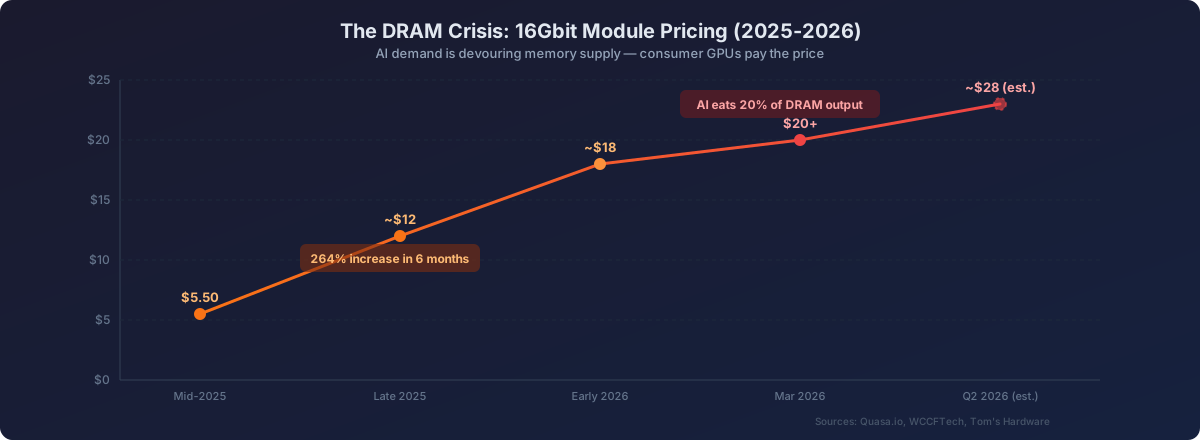
Here is how it breaks down. AI data centers run on memory-dense hardware. Nvidia's H200 accelerator uses six stacks of HBM3E per unit, and HBM consumes roughly three times the wafer capacity of standard DDR5. As hyperscalers like Google, Microsoft, and Meta ramp up AI infrastructure spending, they are effectively outbidding the entire consumer electronics industry for memory fab capacity. AI workloads are projected to consume 20% of total global DRAM production in 2026, according to industry analysts.
The result is a cascade that hits gamers directly:
- 16Gbit DRAM modules: $5.50 (mid-2025) to $20+ (March 2026) -- a 264% increase
- Consumer 64GB DDR5 kits: $195 to as high as $788 in some markets
- VRAM cost share: Memory now accounts for up to 80% of a GPU's bill of materials on high-VRAM cards
- Projected timeline: Analysts expect shortages to persist through Q4 2027, possibly into 2028
Memory prices are expected to climb another 40% by Q2 2026. This is not a temporary blip -- it is a structural shift driven by the AI buildout, and it will not reverse until memory manufacturers bring significant new fab capacity online.
Nvidia Confirms the Shortage: RTX 50 Supply Crunch
Nvidia CFO Colette Kress acknowledged the problem directly: "As much as we would love to have more supply, we do believe for a couple of quarters, it is going to be very tight." Improvements are not expected until late 2026 at the earliest.
The numbers paint a stark picture. RTX 50 series supply in H1 2026 is estimated to be 30 to 40 percent lower than the same period last year. Nvidia has responded by making strategic cuts:
- RTX 5060 Ti 16GB: Shipments reduced, with Nvidia pivoting to 8GB variants to conserve memory
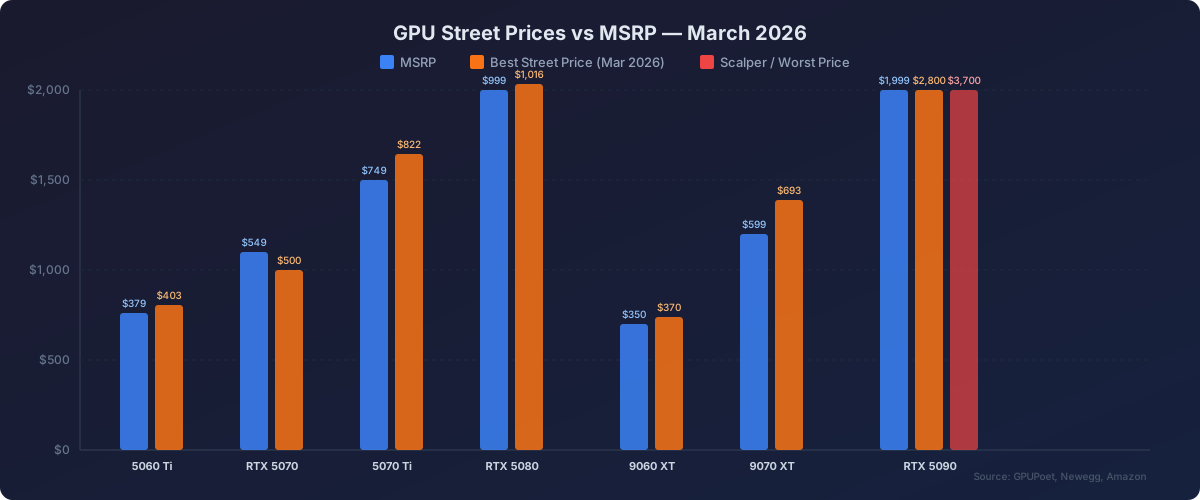
- RTX 5070 Ti: Production constrained, currently selling ~10% above MSRP at $822 for best-available deals
- RTX 5090: The flagship remains a scalper's dream at $2,800+ (MSRP is $1,999), with some aftermarket cards exceeding $3,700
- RTX 50 SUPER refresh: Delayed to Q3 2026 due to GDDR7 constraints
The silver lining -- and it is a thin one -- is that some mid-range cards have actually stabilized or dipped below MSRP. The RTX 5060 is sitting around $270 (MSRP $299), and the RTX 5070 can be found near $500 (MSRP $549). Inventory is improving at major retailers like Best Buy, Newegg, and Micro Center for these specific SKUs.
AMD's Quiet Win: The RX 9070 XT Emerges
While Nvidia grapples with supply allocation, AMD has found itself in an unusual position: the RX 9070 XT has become the most compelling mid-range GPU of the generation. AMD is not immune to the DRAM crisis -- the company is reportedly planning at least a 10% price increase on its graphics cards -- but RDNA 4 architecture brought genuine improvements that make the 9070 XT hard to ignore.
The benchmarks tell the story. At 1440p rasterization, the RX 9070 XT trades blows with the $749 RTX 5070 Ti:
- Dragon's Dogma 2 (1440p): 9070 XT hits 142 FPS vs. the 5070 Ti's 147 FPS -- a 3% gap
- Resident Evil 4 (1440p): 195 FPS vs. 200 FPS
- 4K Dragon's Dogma 2: The 9070 XT achieves 95% of 5070 Ti performance at 80% of its MSRP
On a pure FPS-per-dollar basis, the 9070 XT delivers 19% better value than the RTX 5070. At $600 MSRP (currently ~$693 street price, about 16% above MSRP), it is meaningfully cheaper than both the RTX 5070 Ti ($822) and RTX 5080 ($1,016).
The catch? Ray tracing. In heavy RT workloads, Nvidia still dominates. Black Myth: Wukong with ray tracing at 4K shows the 5070 Ti hitting 52 FPS while the 9070 XT manages just 29 FPS -- a 78% advantage for Nvidia. If path tracing is your priority, AMD is not your card. For everything else, it is a serious contender.
Power consumption is worth noting too: the 9070 XT draws approximately 310W under load, and Nvidia maintains an efficiency advantage. The RTX 5070 Ti is reportedly 48% more energy efficient in workloads like Starfield at 1440p.
What to Buy Right Now: The March 2026 Tier List
Here is the straightforward buying advice, based on actual street prices as of March 23, 2026 -- not MSRPs that may as well be fiction for some cards.
Budget Tier: Under $400
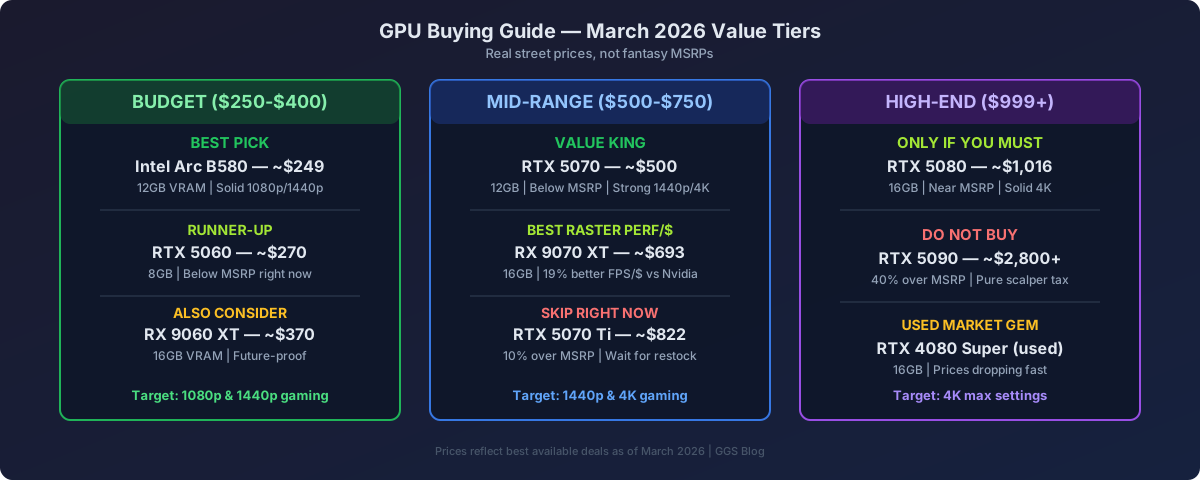
Best pick: Intel Arc B580 (~$249) The Arc B580 remains the value champion at this price point. 12GB of VRAM, solid 1080p and competitive 1440p performance, and it costs less than anything else worth recommending. It is roughly 20% slower than the RTX 5060 or RX 9060 XT, but at $50-120 less, the math works out. Intel's driver situation has improved substantially since launch.
Runner-up: RTX 5060 (~$270) Sitting about 10% below its $299 MSRP, the RTX 5060 is one of the few current-gen cards that is actually a deal right now. The 8GB VRAM limitation stings for future-proofing, but at this price, it is hard to argue against it for 1080p gaming.
Also consider: RX 9060 XT 16GB (~$370) If you can stretch to $370, the 9060 XT 16GB offers double the VRAM of the RTX 5060 and better long-term viability. At only 6% above its $349 MSRP, it is reasonably priced by 2026 standards.
Mid-Range Tier: $500-$750
Best value: RTX 5070 (~$500) The RTX 5070 is the mid-range sweet spot right now. At $500, it is actually below its $549 MSRP, making it one of the best deals in the current market. Strong 1440p performance, decent 4K capability, and full access to DLSS 4 and Nvidia's ray tracing stack. If you want one card to handle everything at 1440p for the next three years, this is it.
Best raster performance per dollar: RX 9070 XT (~$693) The 9070 XT delivers 19% more FPS per dollar than competing Nvidia cards and comes with 16GB of VRAM. The 16% markup over MSRP is annoying but tolerable given the market. If you primarily play rasterized games and want the most raw performance for your money, AMD wins this round.
Skip for now: RTX 5070 Ti (~$822) At 10% above its $749 MSRP, the 5070 Ti is a hard sell when the RTX 5070 sits below MSRP at $500. The performance gap does not justify the 64% price premium at current street prices. Wait for restocks to bring it closer to MSRP.
High-End Tier: $1,000+
If you must: RTX 5080 (~$1,016) The RTX 5080 is within 2% of its $999 MSRP, making it the most "fairly priced" high-end option. Strong 4K performance and 16GB of VRAM. Not a great value compared to the mid-range, but at least you are not feeding scalpers.
Do not buy: RTX 5090 (~$2,800+) The flagship sits 40% above MSRP with some models exceeding $3,700. No GPU is worth paying nearly double its retail price. Period.
Used market gem: RTX 4080 Super Previous-gen prices are plummeting as current-gen inventory slowly improves. A used RTX 4080 Super offers strong 4K performance with 16GB VRAM at a significant discount. Just buy from reputable sellers with return policies.
The 16GB vs 8GB Problem
One of the ugliest consequences of the DRAM crisis is the quiet downgrading of VRAM across the lineup. Nvidia has cut shipments of the RTX 5060 Ti 16GB variant in favor of the 8GB version. The RTX 5070 Ti has faced similar production constraints on its 16GB models.
This matters because modern games are increasingly VRAM-hungry. Titles like Alan Wake 2, Star Wars Outlaws, and Black Myth: Wukong can push past 8GB at 1440p with high texture settings. An 8GB card purchased today may hit a wall within two years as developers continue to target higher-VRAM configurations.
If you are buying a card you plan to keep for three or more years, prioritize 12GB or 16GB VRAM models. The RTX 5060 Ti 8GB at $403 might look attractive, but the RX 9060 XT at $370 gives you 16GB -- double the VRAM for less money. That math is hard to beat.
When Will Prices Stabilize?
The honest answer: not soon. Based on available data, here is a rough timeline:
- Q2 2026: Expect continued tightness. Memory prices may climb another 40%. MSI's 15-30% price hikes will roll through retail channels. AMD's 10%+ increases will follow.
- Q3 2026: Nvidia's RTX 50 SUPER refresh may arrive, potentially improving supply of non-SUPER variants as production shifts. Some stabilization possible at the mid-range.
- Q4 2026 - Q1 2027: Nvidia expects supply to loosen by late 2026. New memory fab capacity from Samsung and SK Hynix should start coming online, easing DRAM constraints.
- 2027-2028: Full recovery. Industry analysts project the DRAM shortage will persist through Q4 2027, with normalization in 2028.
The practical takeaway: if you need a GPU now, buy one of the cards that is at or below MSRP (RTX 5060, RTX 5070, RTX 5080). Waiting six months will not save you money -- prices are going up, not down, through mid-2026. If you can wait a full year, the picture should look meaningfully better.
What This Means for PC Gaming
The 2026 GPU crisis is a stress test for the PC gaming market. When MSI says the PC market will contract 10-20% this year, that is not hyperbole -- fewer people will buy new hardware when a mid-range GPU costs what a high-end card cost two years ago.
The strategic winners are clear. AMD's RDNA 4 lineup, particularly the 9070 XT, has emerged as the go-to recommendation for anyone who is not locked into Nvidia's ecosystem. Intel's Arc B580 continues to punch above its weight at the budget end. And the used GPU market is offering some of the best values we have seen, as previous-gen owners upgrade and flood the secondary market.
For gamers who already have capable hardware -- an RTX 4070 or better, an RX 7900 XT, even an RTX 3080 -- the smartest move might be to sit tight. The games you are playing today will still run fine on last-gen silicon. Upgrading into a market where you are paying a 15-40% premium over MSRP is a losing proposition unless your current card is genuinely failing to deliver playable frame rates.
If you are building a new PC or your current GPU is truly on its last legs, stick to the value tiers outlined above. Buy what is at or below MSRP, prioritize VRAM, and do not feed scalpers. The shortage will end eventually -- the question is whether you can wait.
Sources
- MSI plans 30% gaming product price hike — Tom's Hardware
- MSI Calls 2026 The "Most Difficult" Year — WCCFTech
- MSI confirms GeForce RTX 50 Series shortage — TweakTown
- Nvidia confirms GeForce RTX GPU shortage for 2026 — TweakTown
- AMD RX 9070 XT GPU Review & Benchmarks — GamersNexus
- GPU Prices Set to Skyrocket in 2026: The Memory Crisis — Quasa.io
- AMD to raise graphics card prices by at least 10% — Tom's Hardware
- GPU Market March 2026 Report — GPUPoet
- Nvidia RTX 5070 vs AMD RX 9070 Face Off — Tom's Hardware
- The GPU you can actually buy in 2026 — XDA Developers
- Best Graphics Cards in 2026 — PC Gamer
- NVIDIA rumored to cut GeForce RTX 50 supply in H1 2026 — VideoCardz

Founder of GGS Blog and Site Reliability Engineer at Box. I write about gaming, AI in gaming, and game development with a technical lens — 10+ years in software engineering, 20+ years as a gamer. My work focuses on what the tech actually means for players.
Never miss a post
Subscribe to the GGS Blog newsletter for gaming news, tech insights, and AI in the game industry — delivered straight to your inbox.
Free. No spam. Unsubscribe in one click.
Comments
What to Read Next
Continue exploring our coverage of gaming, technology, and AI.
 Technology
Valve's 44% Steam Deck Hike Is the Only Honest Price in Handhelds
Sony added $100-150, Microsoft $100-150, Nintendo $50. Valve added $240 to a 512GB Steam Deck OLED and said nothing. Only one of those companies has no software subsidy to hide the memory bill behind.
 Technology
You Can't Solo Queue Loneliness: The Real State of AI Gaming Companions
AI teammates that fight, loot, and revive are finally shipping — but they only work in the specific games their publishers built them into. Universal companions exist too, but they're spectators. Neither fully solves what a solo player actually needs.
 Technology
Meta's Horizon Worlds VR Whiplash and the Slow Death of the Metaverse Dream
Meta announced it was killing Horizon Worlds in VR, reversed course 48 hours later, and accidentally wrote the eulogy for a $80 billion bet on virtual reality. Here's what went wrong — and what VR actually needs to survive.