
NVIDIA DLSS 5 Just Changed Everything We Know About Game Graphics
Jensen Huang just dropped a bombshell at GTC 2026, and it might be the biggest graphics announcement since NVIDIA introduced real-time ray tracing in 2018.
DLSS 5 isn't an incremental update. It's not DLSS 4.5 with better frame generation. It's a fundamental rethinking of what upscaling technology can do — moving beyond performance boosts into territory that makes games look like Hollywood VFX renders. In real time. At 4K.
"DLSS 5 is the GPT moment for graphics," Huang said on stage. And for once, the hyperbole might actually be justified.
What DLSS 5 Actually Does (And Why It's Different)
Every version of DLSS until now has been about performance. DLSS 1 upscaled resolution. DLSS 2 got smarter about it. DLSS 3 generated entire frames. DLSS 4 and 4.5 pushed multi-frame generation to the point where AI was drawing 23 out of every 24 pixels on your screen.
DLSS 5 changes the game entirely. Instead of just making things faster, it makes things look better — fundamentally better.
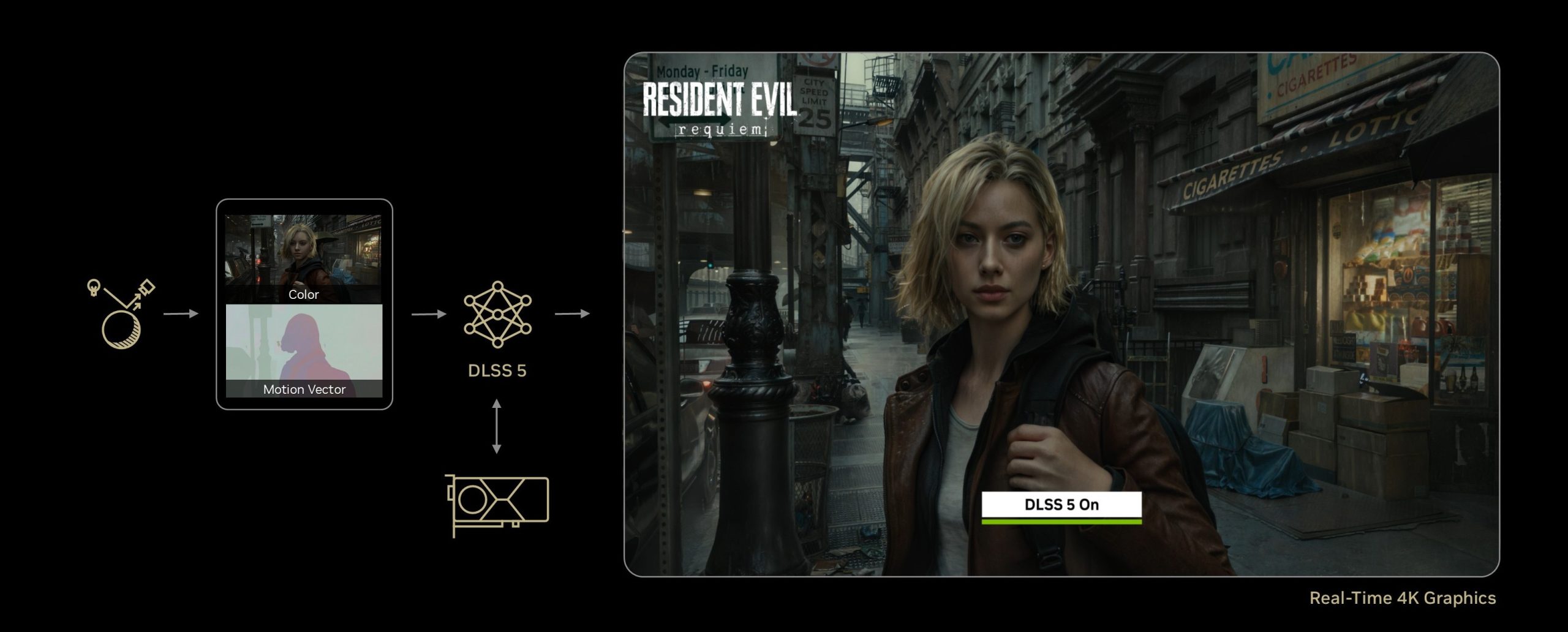
Here's how it works: DLSS 5 takes a game's rendered frame — the color data and motion vectors — and runs it through a neural rendering model trained to understand complex scene semantics. We're talking about an AI that can look at a single frame and understand what's a character, what's hair, what's fabric, what's skin, and how light should interact with each of those materials.
The model then "infuses" the scene with photoreal lighting and materials. Subsurface scattering on skin that makes characters look alive. The delicate sheen of fabric that catches light naturally. Hair that reacts to environmental lighting like it would in the real world. All of this is anchored to the game's actual 3D content — it's not hallucinating new geometry or making things up. It's enhancing what's already there with physically accurate lighting that would normally take minutes or hours to render offline.
The critical distinction from video AI models (like the ones generating clips on social media) is control and determinism. Game graphics need to be predictable. Every frame needs to be consistent. You can't have an AI that decides a character's hair color should change between frames. DLSS 5's output is deterministic, temporally stable, and tightly grounded in the developer's original 3D world.
The Before/After Is Staggering
NVIDIA showed several comparison demos during the GTC keynote, and the results are genuinely hard to believe.
Take Starfield. The base game looks fine — it's a modern AAA title. But with DLSS 5 enabled, it transforms into something that looks like it was rendered on a completely different engine. Skin looks like actual skin. Metal has depth and reflectivity that wasn't there before. Environmental lighting wraps around objects in a way that feels natural rather than approximated.
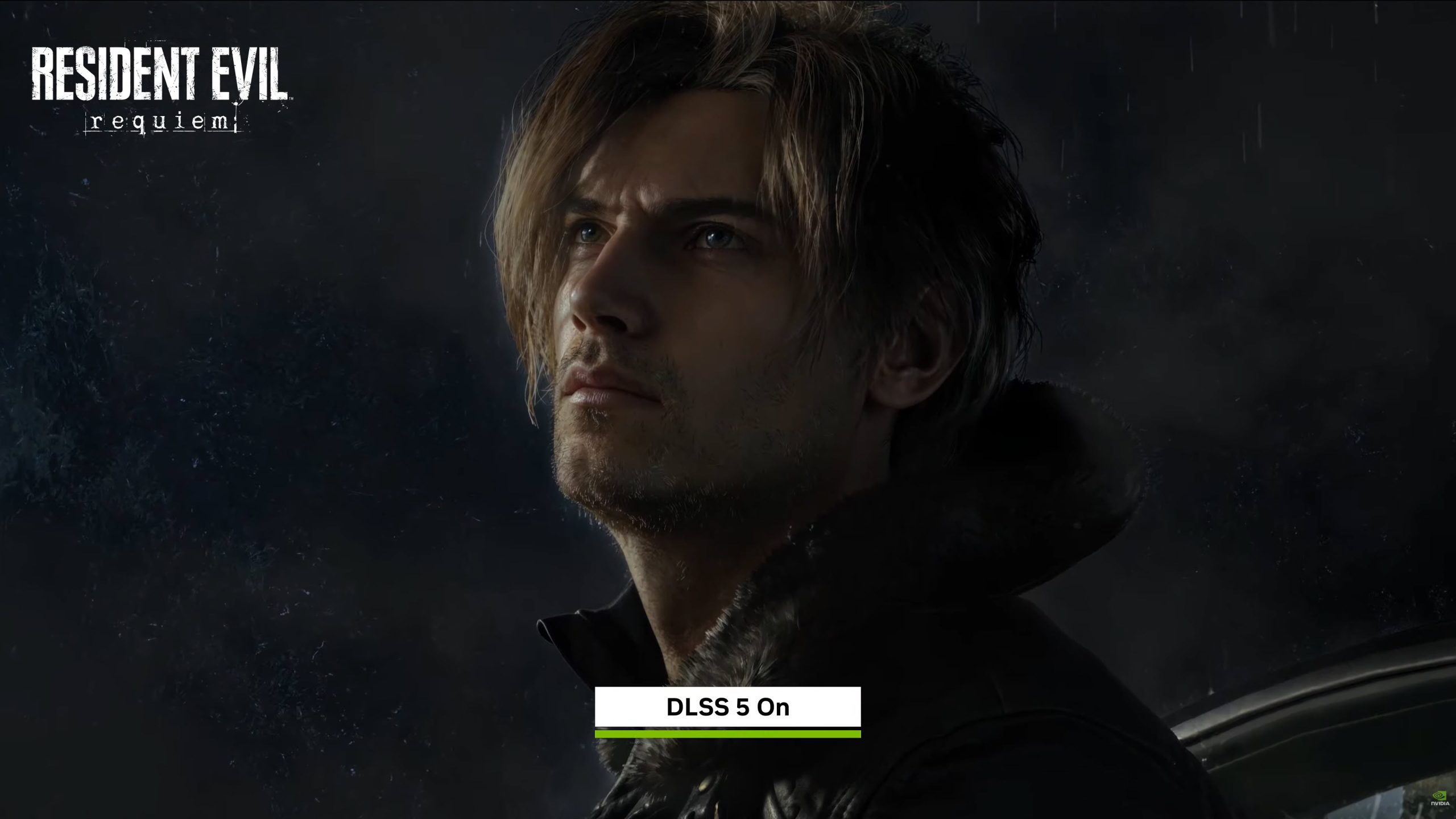
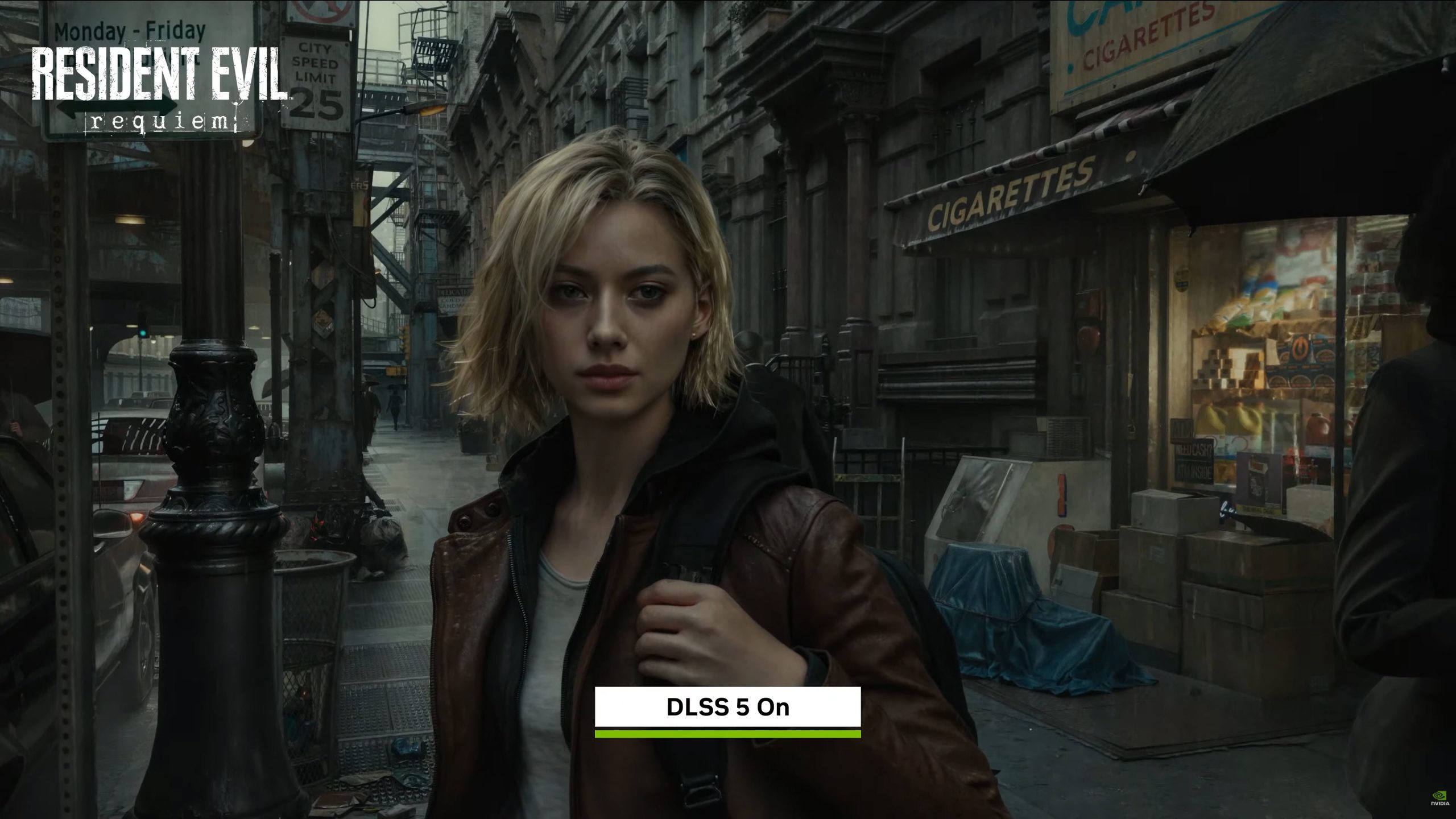
The Resident Evil Requiem demo was equally impressive. A game that already has leading-edge path-traced graphics was further enhanced — shadows gained depth, skin caught light with subsurface accuracy, and fabric textures went from "good" to "I can see the thread count."
Here's Jensen Huang's own description of the technical approach:
"We fused controllable 3D graphics, the ground truth of virtual worlds, the structured data of generated worlds. We combined 3D graphics with generative AI and probabilistic computing. One of them is completely predictive, the other one is probabilistic yet highly realistic. We combined these two ideas — controlled through structured data, controlled perfectly, and yet generating at the same time."
Translation: DLSS 5 takes the precision of traditional rendering and merges it with the realism of generative AI, keeping developers in full control of the output.
The YouTube Demo — Watch It Yourself
NVIDIA released an official announcement trailer showing DLSS 5 in action across multiple titles. The video demonstrates before/after comparisons in Resident Evil Requiem, Starfield, Hogwarts Legacy, and EA Sports FC '26.
The motion footage is where DLSS 5 really shows its strength. Screenshots are impressive, but seeing light interact with materials in real time — fabric catching environmental light as a character moves, skin changing tone as shadows shift across a face — that's the moment it clicks. This isn't a filter. It's a fundamentally different rendering approach.
Digital Foundry has also published their own analysis video if you want a more technical deep-dive from an independent source.
What Hardware Do You Need?
Here's the fine print: the GTC demo ran on two RTX 5090s in parallel. Before you close this tab, NVIDIA confirms that DLSS 5 will be "entirely usable on a system with a single RTX 50 GPU." The dual-GPU setup was likely for the 4K demo presentation, not the minimum spec.
That said, DLSS 5 is clearly designed for RTX 50 Series (Blackwell) hardware. Whether older RTX 40 or 30 series cards will see any support remains unclear, but given the neural rendering workload, this seems like a Blackwell-and-beyond technology. NVIDIA is pushing the Tensor Core capabilities of its newest architecture hard.
The technology runs at up to 4K resolution in real time for "smooth, interactive gameplay" — though NVIDIA hasn't disclosed specific framerates or performance overhead yet. Expect more details as we get closer to the fall launch.
Developer Support Is Already Massive
NVIDIA isn't launching DLSS 5 into a vacuum. Major publishers are already onboard:
Studios confirmed: Bethesda, Capcom, Hotta Studio, NetEase, NCSOFT, S-Game, Tencent, Ubisoft, and Warner Bros. Games.
Games confirmed for DLSS 5 support:
- Resident Evil Requiem
- Starfield
- Hogwarts Legacy
- Assassin's Creed Shadows
- The Elder Scrolls IV: Oblivion Remastered
- Delta Force
- Naraka: Bladepoint
- Phantom Blade Zero
- Sea of Remnants
- Where Winds Meet
- Black State
- CINDER CITY
- NTE: Neverness to Everness
- AION 2
- Justice
Todd Howard specifically called out the Starfield implementation: "When NVIDIA showed us DLSS 5 and we got it running in Starfield, it was amazing how it brought it to life. We've played it. We can't wait for all of you to do so as well."
Capcom's Jun Takeuchi framed it around immersion: "DLSS 5 represents another important step in pushing visual fidelity forward, helping players become even more immersed in the world of Resident Evil."
Integration uses the same NVIDIA Streamline framework that existing DLSS and Reflex implementations use, which means adding DLSS 5 to games that already support DLSS should be relatively straightforward for developers.
Developer Controls — Why This Isn't Just a "Filter"
One of the most important details that could get lost in the hype: DLSS 5 gives developers granular control over the enhancement.
- Intensity controls — dial up or down how much neural rendering is applied
- Color grading — maintain the game's artistic color palette
- Masking — specify which parts of the scene get enhanced and which don't
This matters because not every game wants photorealism. A cel-shaded game like Hi-Fi Rush or a stylized game like Hades shouldn't have its art direction overridden by an AI trying to make everything look like a photograph. DLSS 5's masking system lets developers protect their artistic vision while selectively applying neural rendering where it makes sense.
HotHardware's reporting notes that "cartoony or cel-shaded games will require different optimizations than more photorealistic titles, so developers will be able to tweak DLSS 5 as necessary." This suggests NVIDIA has thought carefully about the art direction problem — a good sign for the technology's long-term adoption.
The Bigger Picture: From Performance to Visual Fidelity
DLSS 5 represents a philosophical shift for NVIDIA's AI graphics strategy.
The DLSS story so far has been: "AI makes games run faster." DLSS 5's story is: "AI makes games look better than was previously possible in real time." The performance angle isn't gone — upscaling and frame generation are still part of the DLSS suite — but the focus has expanded to include visual quality as a first-class output.
This matters for the industry because it addresses a fundamental ceiling. NVIDIA's own framing makes this explicit: a game frame renders in 16 milliseconds. A Hollywood VFX frame can take minutes to hours. No amount of brute-force hardware will close that gap in real time. Neural rendering is NVIDIA's bet that AI can bridge the difference — not by rendering faster, but by understanding what photoreal lighting should look like and intelligently applying it.
The 375,000x increase in compute that NVIDIA has delivered since the original GeForce still can't match offline rendering. But an AI trained on what "correct" lighting looks like? That might actually get us there.
The Questions That Remain
DLSS 5 looks incredible in controlled demos, but several important questions need answers before we break out the champagne:
- Performance overhead — How much does neural rendering cost in frames? If it tanks performance, it defeats the purpose.
- RTX 40/30 support — Will older hardware be left behind entirely?
- Artifact handling — Video AI models hallucinate. How does DLSS 5 handle edge cases, fast motion, or unusual art styles?
- AMD and Intel response — FSR and XeSS will need to evolve. Will they pursue similar neural rendering approaches?
- Real-world vs. demo — Controlled keynote demos always look great. How does it perform across thousands of different games with different engines?
When Can You Get It?
DLSS 5 arrives this fall (2026) for GeForce RTX 50 Series GPUs. NVIDIA is showing previews at GTC this week, with more details expected throughout the summer.
If you already own an RTX 5090, 5080, or 5070 — you're in the target audience. If you're on older hardware, this might be the feature that finally justifies an upgrade. And if you're on AMD or Intel... well, the ball is in their court now.
One thing is certain: the line between "game graphics" and "movie graphics" just got a lot blurrier.
Sources
- NVIDIA Official: DLSS 5 Delivers AI-Powered Breakthrough in Visual Fidelity for Games
- NVIDIA Newsroom: DLSS 5 Announcement
- WCCFTech: NVIDIA DLSS 5 Announced — Game-Changing Visual Uplifts
- HotHardware: NVIDIA DLSS 5 Paints Game Graphics With AI-Infused Photorealistic Details
- IGN: NVIDIA DLSS 5 Official Announcement Trailer
- YouTube: NVIDIA DLSS 5 Official Trailer

Founder of GGS Blog and Site Reliability Engineer at Box. I write about gaming, AI in gaming, and game development with a technical lens — 10+ years in software engineering, 20+ years as a gamer. My work focuses on what the tech actually means for players.
Never miss a post
Subscribe to the GGS Blog newsletter for gaming news, tech insights, and AI in the game industry — delivered straight to your inbox.
Free. No spam. Unsubscribe in one click.
Comments
What to Read Next
Continue exploring our coverage of gaming, technology, and AI.
 Technology
Valve's 44% Steam Deck Hike Is the Only Honest Price in Handhelds
Sony added $100-150, Microsoft $100-150, Nintendo $50. Valve added $240 to a 512GB Steam Deck OLED and said nothing. Only one of those companies has no software subsidy to hide the memory bill behind.
 Technology
You Can't Solo Queue Loneliness: The Real State of AI Gaming Companions
AI teammates that fight, loot, and revive are finally shipping — but they only work in the specific games their publishers built them into. Universal companions exist too, but they're spectators. Neither fully solves what a solo player actually needs.
 Technology
Meta's Horizon Worlds VR Whiplash and the Slow Death of the Metaverse Dream
Meta announced it was killing Horizon Worlds in VR, reversed course 48 hours later, and accidentally wrote the eulogy for a $80 billion bet on virtual reality. Here's what went wrong — and what VR actually needs to survive.