
Valve's New Steam Machine Is Real, It's Powerful, and It Might Actually Work This Time
Valve Is Trying the Console Thing Again. This Time It Built the Hardware Itself.
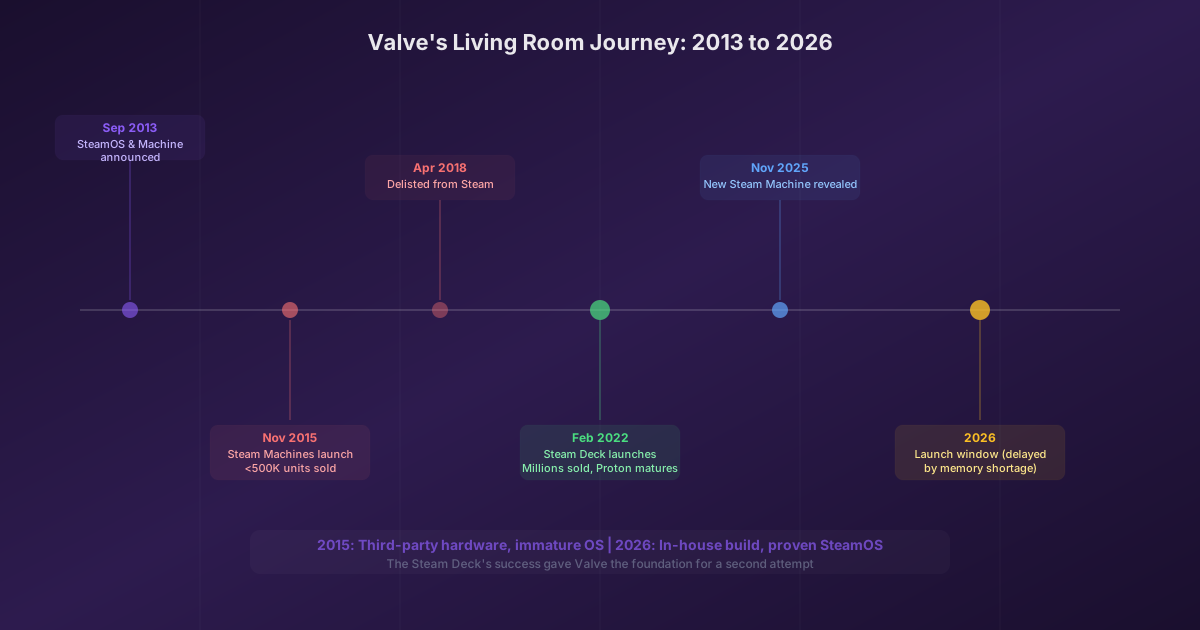
In November 2015, Valve launched the original Steam Machines — a lineup of third-party Linux PCs designed to bring Steam into the living room. They were overpriced, underpowered relative to comparable Windows PCs, ran an immature operating system with poor game compatibility, and quietly disappeared from the Steam store by 2018. It was one of the most high-profile hardware flops in gaming history.
Now Valve is trying again. On November 12, 2025, the company announced a new Steam Machine alongside a redesigned Steam Controller and a standalone VR headset called Steam Frame. Unlike the 2015 version, Valve is building all of this hardware in-house — no third-party partners, no fragmented SKUs, no Alienware boxes running SteamOS with an asterisk.
The pitch is straightforward: a compact PC that plugs into your TV, runs SteamOS, plays the vast majority of Steam's library, and delivers performance that Valve claims is "six times more powerful than the Steam Deck." Valve wants this to be the PC-powered console alternative that the original Steam Machines never managed to become.
But between a global memory shortage driving up component costs, a leaked price that horrified potential buyers, and an anti-cheat problem that still locks out hundreds of popular games, Valve's second attempt at the console market is already navigating turbulence before it even ships.
What's Inside the Box: Hardware Specifications
The new Steam Machine is housed in a compact black cube measuring roughly 6 x 6.4 x 6.1 inches — small enough to sit next to a TV without looking like a desktop PC. It weighs about 2.6 kilograms and can be positioned horizontally or vertically. There's a removable faceplate and a customizable LED status strip along one edge.
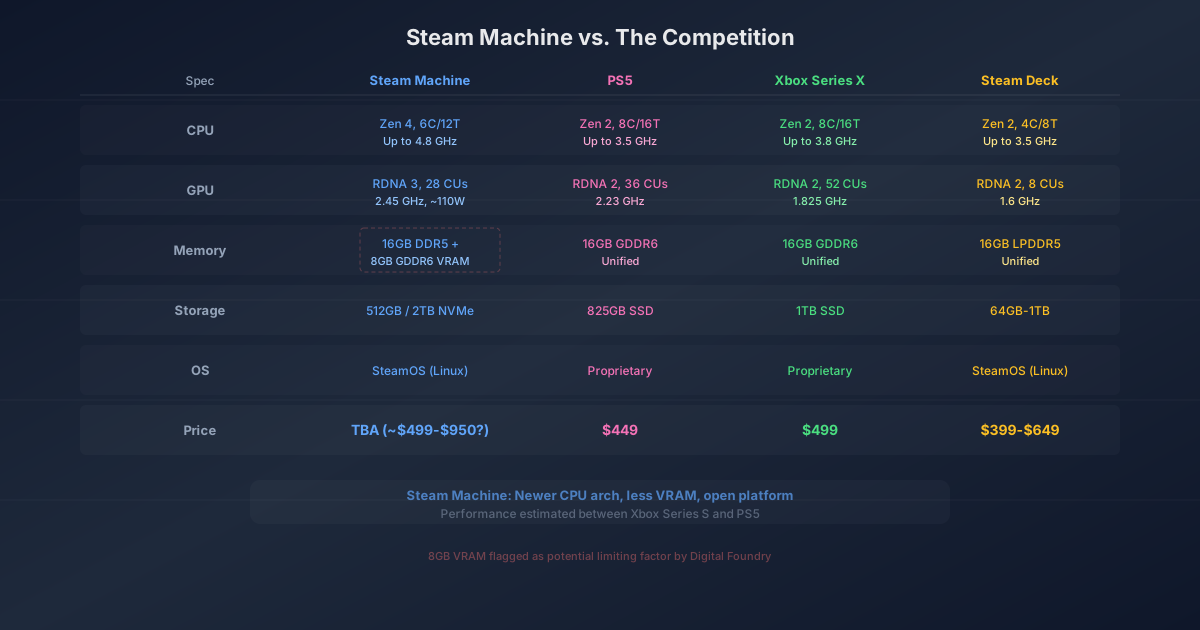
Inside, it's running a semi-custom AMD Zen 4 CPU with 6 cores and 12 threads, clocking up to 4.8 GHz at a 30W TDP. At just 30W TDP, its CPU performance lands closer to a laptop-class Ryzen 5 8640HS than a full desktop 7600X, despite sharing the same Zen 4 core count. The GPU is a semi-custom RDNA 3 chip with 28 compute units at 2.45 GHz, drawing approximately 110W. Performance sits below a standalone Radeon RX 7600 but meaningfully above any handheld on the market.
Memory is where things get interesting — and contentious. The system has 16GB of DDR5 system RAM via SODIMM modules (which Valve says will be user-upgradeable) plus 8GB of dedicated GDDR6 VRAM for the GPU. Storage comes in 512GB or 2TB NVMe SSD options, with a microSD slot for expansion.
Connectivity
The rear panel offers a solid selection of ports: DisplayPort 1.4 (supporting up to 4K@240Hz or 8K@60Hz), HDMI 2.0 (4K@120Hz via chroma subsampling, SDR only at that mode), four USB-A ports (two 3.2 Gen 1, two 2.0), one USB-C 3.2 Gen 2, Gigabit Ethernet, Wi-Fi 6E, Bluetooth 5.3, and an integrated 2.4GHz wireless adapter for the Steam Controller.
Valve advertises that "the majority of Steam titles play great at 4K 60FPS" using AMD's FSR upscaling technology. The more realistic expectation, according to Digital Foundry's hands-on analysis, is solid 1080p or 1440p performance at high settings, with 4K requiring a mix of medium-to-high settings plus FSR to hit smooth frame rates — especially in demanding modern titles.
The VRAM Question: 8GB in 2026
The most discussed technical concern about the Steam Machine is its 8GB of GDDR6 VRAM. Digital Foundry flagged this as a potential limiting factor, noting that it "falls short of the maximum VRAM pools and memory bandwidth available on both Xbox Series X and base PS5."
Both the PlayStation 5 and Xbox Series X use 16GB of GDDR6 shared between CPU and GPU — though the Xbox splits this into a 10GB pool at 560 GB/s and a 6GB pool at 336 GB/s, while the PS5's pool is truly unified at 448 GB/s. The Steam Machine separates these into 16GB DDR5 (system) and 8GB GDDR6 (GPU), which means the GPU has access to less memory than current-gen consoles despite being a newer architecture.
At 1080p and 1440p, 8GB VRAM handles today's games without issue. But at 4K with high-resolution textures and ray tracing — the exact scenario Valve is marketing — 8GB gets tight. Games like Alan Wake 2, Cyberpunk 2077, and The Last of Us Part I already push past 8GB at ultra settings on PC. Two or three years from now, that constraint will be more pronounced.
Digital Foundry's initial assessment positions the Steam Machine's overall performance at roughly between an Xbox Series S and a standard PlayStation 5, likely skewing closer to the PS5 in most scenarios. That is respectable for a small-form-factor PC, but it means this is not a PS5 Pro competitor — it's an alternative for people who want PC gaming's flexibility in a console-like package.
The Ghost of Steam Machines Past
Understanding why the new Steam Machine matters requires understanding why the original failed so badly.
The 2015 Steam Machines were not one product — they were a concept. Valve published a set of minimum hardware specifications and invited third-party manufacturers to build PCs that met them. Companies like Alienware, iBuyPower, Syber, and others produced their own versions, each with different hardware, different price points, and different designs. Some cost $450. Others cost $5,000. The result was a confusing mess that looked nothing like the streamlined console experience Valve was promising.
The hardware fragmentation was compounded by software problems. SteamOS in 2015 was based on Debian Linux, and game compatibility was abysmal. Most AAA titles simply did not run. The Steam Controller, while innovative with its dual trackpads, had a steep learning curve that put off mainstream users. By the time Valve quietly removed the Steam Machine category from the Steam store's main navigation in April 2018, fewer than 500,000 units had been sold across all manufacturers.
The new approach fixes nearly every structural problem from the first attempt:
- Single manufacturer: Valve builds all hardware itself — no third-party fragmentation
- Mature software: SteamOS 3, now based on Arch Linux with KDE Plasma, is battle-tested through millions of Steam Decks
- Proton compatibility: The Proton translation layer can run the vast majority of Windows games on Linux, something that did not exist in 2015
- Proven market: The Steam Deck demonstrated that people want to play their Steam libraries on dedicated hardware beyond traditional PCs
The Steam Deck's success is the single biggest reason the new Steam Machine has credibility. Valve sold millions of Decks, built a thriving ecosystem around SteamOS, proved that Proton could handle most of the Windows gaming library, and created a "Verified" and "Playable" rating system that gives buyers confidence about compatibility. The new Steam Machine inherits all of that infrastructure on day one.
The $950 Leak That Nobody Wanted to See
In January 2026, a Czech retailer called Smarty.cz published listings for the Steam Machine with prices hidden in the page source code. The 512GB model was listed at 19,826 CZK (approximately $950 USD), and the 2TB model at 22,305 CZK (approximately $1,070 USD).
The gaming internet reacted with predictable horror. At those prices, the Steam Machine would cost more than a PS5, more than an Xbox Series X, and more than many entry-level gaming PCs running Windows.
There are reasons to be skeptical of those numbers. The listings lacked proper product codes or EAN/UPC identifiers, suggesting they were placeholders rather than confirmed retail prices. European retailers consistently price Valve hardware higher than Valve's direct store — the Steam Deck OLED, for example, often costs 15-25% more through third-party European shops than through Steam. And Czech Republic prices include VAT, which inflates the sticker price compared to US pricing.
Valve has not announced official pricing. The company has said the Steam Machine will be "comparable to a PC with similar specs" and positioned at the "entry level of PC space." Analysts have speculated a US price between $499 and $699 for the base model, which would put it in a more competitive range — though still above the $449 PS5 and $499 Xbox Series X.
But here is the problem: the global memory shortage is actively pushing costs up, and Valve has publicly acknowledged that component prices are affecting its plans. Whatever the original target price was, it may no longer be achievable.
The Memory Crisis Hanging Over Everything
In February 2026, Valve posted an update acknowledging that "memory and storage shortages have created challenges for us." This was not corporate vagueness — it was a reference to one of the most significant supply chain disruptions since the pandemic-era chip shortage.
The 2024-2026 global memory shortage is fundamentally different from the 2020-2023 chip crunch. That earlier shortage was caused by pandemic-related factory closures and logistics breakdowns. The current one is caused by artificial intelligence.
The three largest memory manufacturers — Samsung, SK Hynix, and Micron — have aggressively pivoted their production capacity toward High Bandwidth Memory (HBM) chips used in AI accelerators like NVIDIA's H100 and H200 GPUs. The margins on HBM are enormous compared to standard DDR5 or GDDR6, and the demand from hyperscalers like Microsoft, Google, Meta, and Amazon is seemingly bottomless. According to Tom's Hardware, data centers are projected to consume 70% of all memory chips produced in 2026.
The result: DRAM prices have skyrocketed. DDR5 prices surged over 400% since September 2025, according to Micron data, and analysts forecast prices could nearly double again quarter-over-quarter in early 2026. DDR5 SODIMM modules — the exact type used in the Steam Machine — have seen some of the steepest increases. Any consumer electronics product that uses RAM is affected, but gaming hardware that requires both system RAM and dedicated VRAM is hit particularly hard.
This is why Valve's release timeline has been slipping. The original promise was "early 2026." That became "first half of 2026." Then a March 2026 blog post used the language "we hope to ship in 2026" — which sounded like the timeline was slipping to 2027. Valve quickly clarified through PR representative Kaci Aitchison Boyle, telling The Verge: "Nothing has actually changed on our end." The company updated its page to confirm all three products would ship this year.
But the memory shortage is not going away. Industry analysts expect it to persist through 2026 and into 2027. US-China trade tensions and tariff escalations have further complicated the supply chain, as restrictions on semiconductor equipment exports to Chinese manufacturers have tightened supply even further.
The Full Hardware Trilogy: Controller and Steam Frame
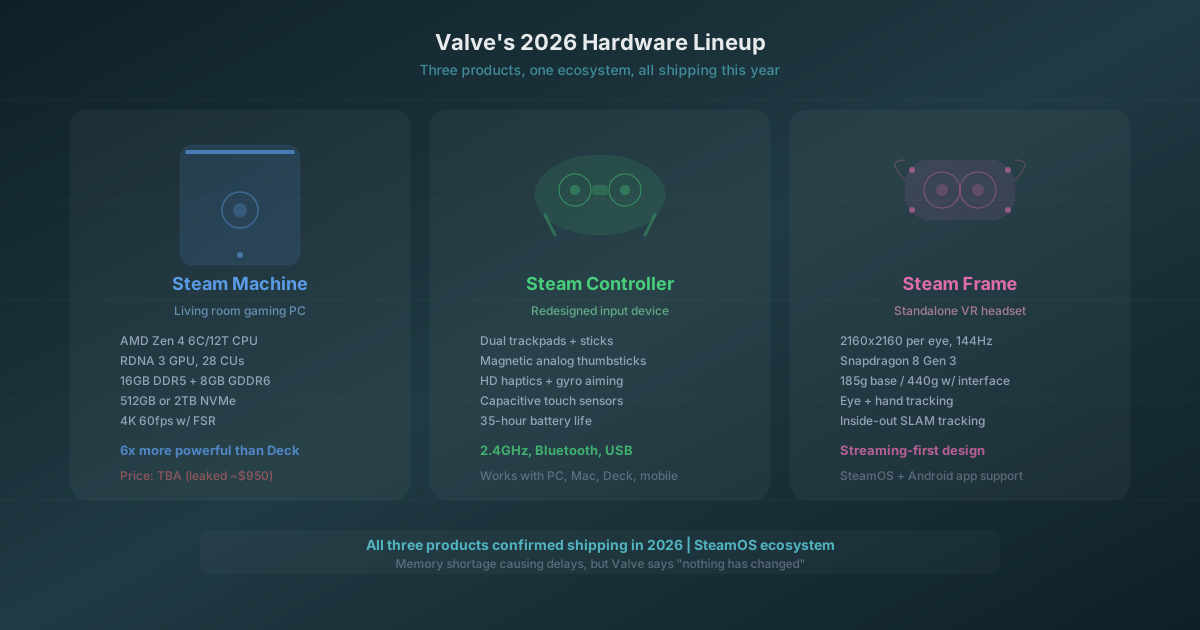
The Steam Machine is not launching alone. Valve announced two companion products that together form a complete hardware ecosystem.
Steam Controller (2026)
The new Steam Controller brings back the dual trackpads that defined the original but adds features that address its predecessor's weaknesses:
- Magnetic analog thumbsticks for improved precision and long-term durability
- High-definition haptics and capacitive sensors across the input surfaces
- Gyro aiming for mouse-like precision in shooters
- 35-hour battery life
- Connectivity via low-latency 2.4GHz wireless, Bluetooth, or USB
- Compatible with PC, Mac, Steam Deck, Linux, and mobile devices
The original Steam Controller was polarizing — beloved by enthusiasts who mastered its trackpads, dismissed by mainstream gamers who just wanted analog sticks. The 2026 version tries to serve both audiences.
Steam Frame
Steam Frame is Valve's next-generation VR headset and the successor to the Valve Index. Key specifications:
- Display: Dual 2160x2160 LCD panels at 144Hz
- Processor: Snapdragon 8 Gen 3 for standalone play
- Weight: 185 grams (base unit), 440 grams with facial interface
- Tracking: Inside-out via four monochrome cameras plus infrared emitters
- Features: Eye tracking, hand tracking, passthrough cameras
- Software: SteamOS-based, with Proton compatibility and Android app support
Steam Frame is described as a "streaming-first" headset, meaning it can play demanding PC VR games by streaming from a nearby PC (including the Steam Machine) while handling simpler titles natively. At 185 grams for the base unit, it would be one of the lightest VR headsets on the market.
The Anti-Cheat Problem That Will Not Go Away
If there is one issue that could undermine the Steam Machine's viability as a console replacement, it is anti-cheat compatibility.
SteamOS runs Linux. Many competitive multiplayer games use kernel-level anti-cheat software — primarily Easy Anti-Cheat (EAC) and BattlEye — that was designed for Windows. While both EAC and BattlEye technically support Linux through Proton, individual game developers must explicitly enable that support. Many have not.
According to Are We Anti-Cheat Yet, a crowd-sourced compatibility database, 682 out of 1,136 games that require anti-cheat software do not work on SteamOS. That is more than 60% of games with anti-cheat. Major titles affected include Fortnite, PUBG, Destiny 2, Roblox, and numerous other multiplayer games that represent a significant portion of daily Steam activity.
Valve has acknowledged this directly. A Valve representative stated that anti-cheat will not be "miraculously solved" by launch, but expressed hope that growing SteamOS market share — driven by the Steam Deck and now the Steam Machine — will incentivize more developers to enable Linux support in their anti-cheat implementations.
The logic is sound in theory: as the SteamOS user base grows, the business case for supporting it improves. But this is a chicken-and-egg problem. Gamers will not buy a Steam Machine if it cannot run the multiplayer games they play, and developers will not prioritize SteamOS support until enough gamers are using it.
For single-player games, retro gaming, indie titles, and many cooperative multiplayer games, the Steam Machine will work beautifully. But anyone whose primary gaming diet consists of competitive shooters and live-service multiplayer games needs to check the compatibility list carefully before buying.
Who Is This Actually For?
The Steam Machine sits in a market position that does not have many direct competitors, which is both its advantage and its challenge.
It is for people who want PC gaming without a PC. The living room gamer who wants access to Steam sales, their existing library, mods, and the open PC ecosystem, but does not want to build or maintain a desktop computer. The Steam Machine offers that in a form factor comparable to a console.
It is for Steam Deck owners who want a more powerful companion. If you already own a Steam Deck and have invested in SteamOS, the Steam Machine is the obvious big-screen counterpart. Your saves sync via Steam Cloud, your library carries over, and the UI is identical.
It is for Linux enthusiasts who want a gaming-focused appliance. The original Steam Machines were ahead of their time — SteamOS was not ready, Proton did not exist, and the game library on Linux was tiny. In 2026, the foundation is dramatically stronger.
It is probably not for people who already have a gaming PC. If you have a mid-range or better Windows desktop, the Steam Machine offers less power, fewer compatible games (due to anti-cheat), and no access to Game Pass or other Windows-exclusive services.
It is probably not for people buying their first console. The PS5 and Xbox Series X are cheaper (assuming the price leak is directionally accurate), have no anti-cheat compatibility issues, and offer exclusive first-party games that the Steam Machine cannot match.
What Happens Next
Valve has committed to shipping the Steam Machine, Steam Controller, and Steam Frame before the end of 2026. The company's repeated reaffirmations — "nothing has actually changed on our end" — suggest internal confidence despite external supply chain pressures.
The critical unknowns remain:
-
Price. If Valve can hit $499-$599, it has a real product. If memory costs push it toward $800-$900, it becomes a hard sell against consoles and entry-level gaming PCs.
-
Anti-cheat adoption. Every major multiplayer game that enables Linux anti-cheat support before or shortly after launch strengthens the Steam Machine's case. Every game that does not is a reason for multiplayer-focused gamers to stick with Windows or consoles.
-
The memory shortage trajectory. If DRAM and GDDR6 prices stabilize or decline in the second half of 2026, Valve may be able to price competitively. If the shortage deepens — as some analysts predict — the economics become increasingly difficult.
-
The 8GB VRAM question. This is a hardware decision that cannot be changed post-launch. If VRAM-hungry games proliferate faster than FSR improves, the Steam Machine's longevity could be limited compared to consoles with more unified memory.
The Steam Machine in 2026 is a fundamentally better product than anything Valve shipped in 2015. The software is mature. The compatibility layer works. The form factor is right. The ecosystem is established. Whether it succeeds depends on factors largely outside Valve's control — memory prices, anti-cheat developers, and whether the market has room for a third option between console simplicity and PC flexibility.
Valve is betting that it does. The Steam Deck proved that millions of people want Steam on dedicated hardware. The Steam Machine is the next logical step: same idea, bigger screen, more power, plugged into your TV. If Valve can get the price right and the games working, its second attempt at cracking the living room might actually stick.
Sources
- Valve Quickly Updates Its Own Steam Machine Update, Recommitting to a 2026 Launch — PC Gamer
- Valve Changes Steam Machine Release Date to This 'Year' — Tom's Hardware
- Valve Insists It Will Release Steam Machine and Steam Frame in 2026 — VGC
- Steam Machine: Release, Specs and Software — Space4Games
- Everything We Know About Valve's New Steam Machine — Engadget
- Steam Machine Release Date Window, Price Speculation, And Everything We Know — GameSpot
- Steam Machine Price Leak via Czech Retailer — WCCFTech
- Can Valve's New Steam Machine Keep Up With Xbox and PS5? — Windows Central
- Data Centers Will Consume 70% of Memory Chips in 2026 — Tom's Hardware
- Anti-Cheat Will Still Be One of the Biggest Problems for the New Steam Machine — GamingOnLinux
- For the Steam Machine to Change PC Gaming, Valve Must Solve Linux's Anti-Cheat Problem — Engadget
- Valve Steam Frame Official Announcement — UploadVR
- Valve Brings Back Steam Machine and Steam Controller — Hands-On — Tom's Hardware

Founder of GGS Blog and Site Reliability Engineer at Box. I write about gaming, AI in gaming, and game development with a technical lens — 10+ years in software engineering, 20+ years as a gamer. My work focuses on what the tech actually means for players.
Never miss a post
Subscribe to the GGS Blog newsletter for gaming news, tech insights, and AI in the game industry — delivered straight to your inbox.
Free. No spam. Unsubscribe in one click.
Comments
What to Read Next
Continue exploring our coverage of gaming, technology, and AI.
 Technology
Valve's 44% Steam Deck Hike Is the Only Honest Price in Handhelds
Sony added $100-150, Microsoft $100-150, Nintendo $50. Valve added $240 to a 512GB Steam Deck OLED and said nothing. Only one of those companies has no software subsidy to hide the memory bill behind.
 Technology
You Can't Solo Queue Loneliness: The Real State of AI Gaming Companions
AI teammates that fight, loot, and revive are finally shipping — but they only work in the specific games their publishers built them into. Universal companions exist too, but they're spectators. Neither fully solves what a solo player actually needs.
 Technology
Meta's Horizon Worlds VR Whiplash and the Slow Death of the Metaverse Dream
Meta announced it was killing Horizon Worlds in VR, reversed course 48 hours later, and accidentally wrote the eulogy for a $80 billion bet on virtual reality. Here's what went wrong — and what VR actually needs to survive.