
Everything NVIDIA Announced at GTC 2026: From DLSS 5 to Vera Rubin to a Walking Olaf
One trillion dollars. That's NVIDIA's updated projection for AI infrastructure demand through 2027, announced during a two-hour GTC 2026 keynote on March 16 at San Jose's SAP Center. Jensen Huang also revealed a surprise acquisition of Groq, launched the Vera Rubin supercomputer platform with seven chips, previewed DLSS 5's neural rendering, and closed the show by walking a Disney Olaf robot across the stage.
Here's everything that matters from the keynote — organized so you can skip the two-hour video and still have the full picture.
The Big Number: $1 Trillion in AI Demand Through 2027
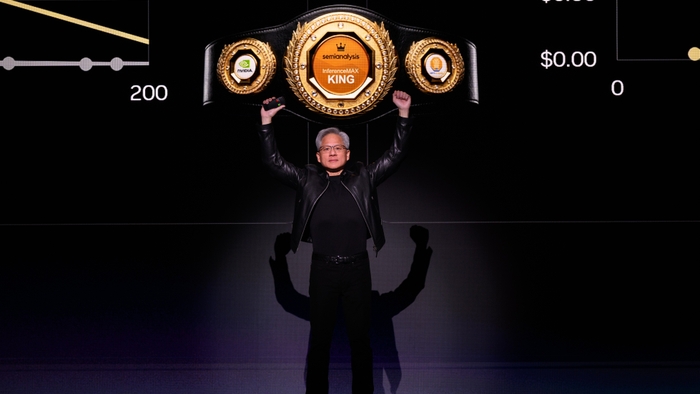
Let's start with the headline number. Huang stated that NVIDIA now sees "through 2027, at least $1 trillion" in high-confidence demand and purchase orders for its Blackwell, Rubin, and future platforms. That's double the $500 billion projection he made at GTC 2025 just one year ago.
To put that in perspective: NVIDIA is projecting more revenue in three years than the entire GDP of the Netherlands.
Huang acknowledged the absurdity with a self-aware quip: "I know why you're not impressed, because all of you had record years." He pointed to NVIDIA's supply chain partners — companies 50, 70, and 150 years old — all hitting revenue peaks in 2025 thanks to AI infrastructure buildout. His verdict: "I'm certain computing demand will be much higher than that."
The math behind the million-times demand increase comes from three AI breakthroughs Huang identified: ChatGPT launching the generative era in late 2022, OpenAI's o1/o3 reasoning models making AI trustworthy through reflection and planning, and Anthropic's Claude Code becoming "the first agentic model" that can autonomously read files, code, compile, test, and iterate.
"For the first time, you don't ask the AI what, where, when, how. You ask it create, do, build," Huang said. "AI now has to think. In order to think, it has to inference."
Vera Rubin: A Seven-Chip Supercomputer for Agentic AI
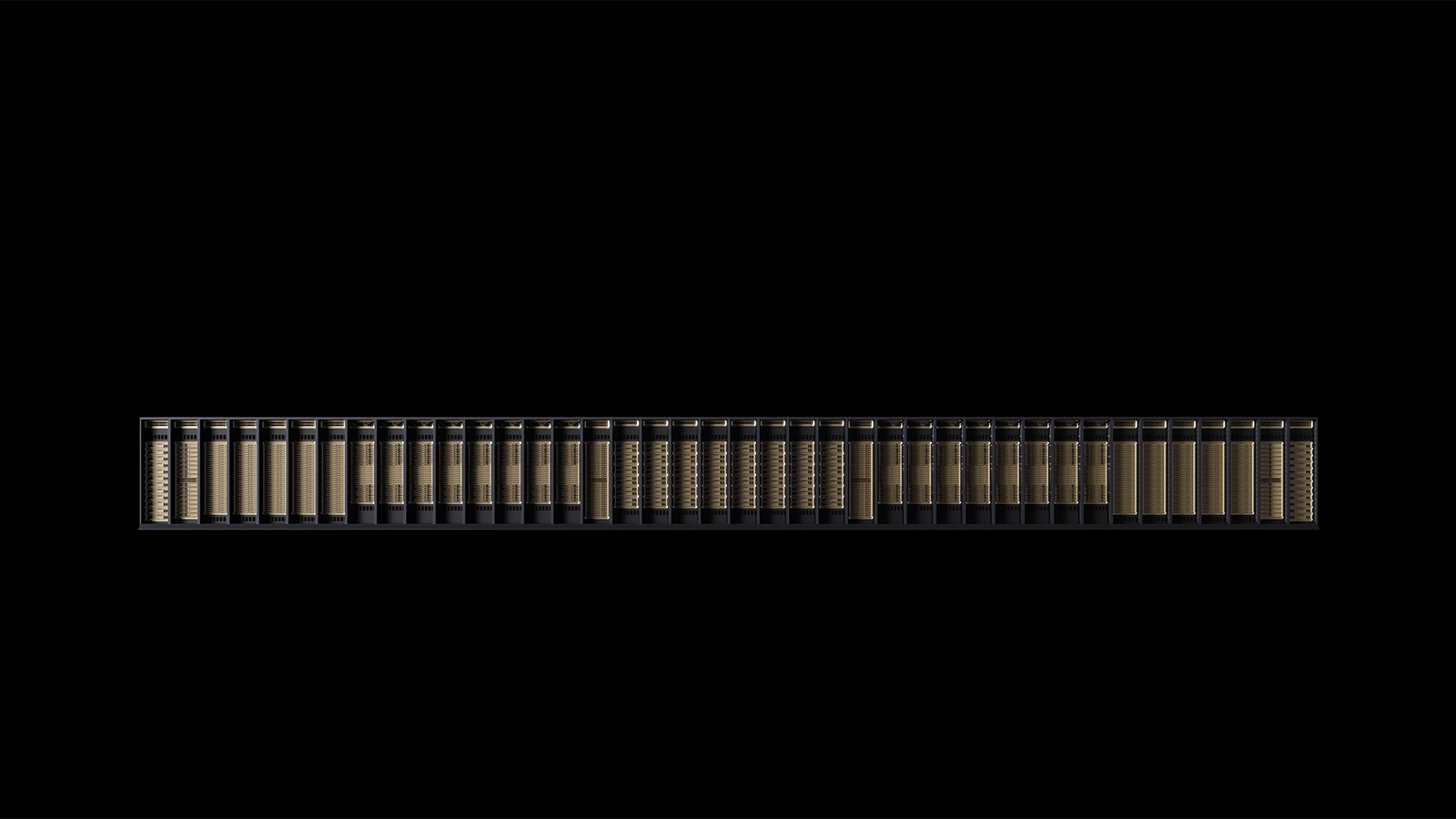
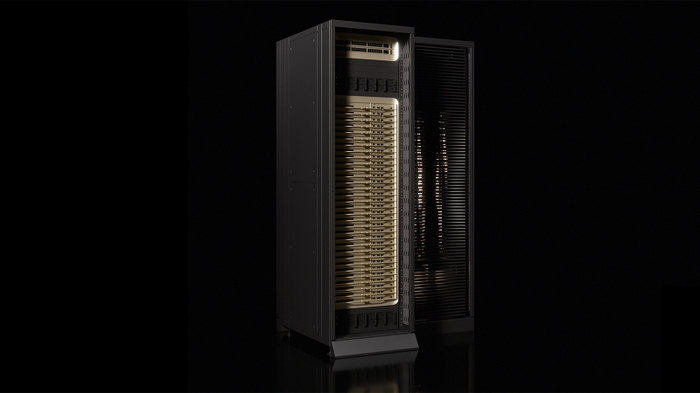
The flagship hardware announcement was Vera Rubin, NVIDIA's next-generation full-stack computing platform purpose-built for agentic AI workloads. This isn't just a new GPU — it's an entire integrated system comprising seven different chips across five rack-scale computers that operate as one unified supercomputer.
The platform includes:
- Vera Rubin GPU with NVLink 72 connecting 72 GPUs
- Vera CPU — NVIDIA's own purpose-built CPU for orchestration
- ConnectX-9 networking
- BlueField-4 STX storage processors
- Spectrum-X Ethernet with co-packaged optics
The complete system delivers 3.6 exaflops of compute with 260 terabytes per second of all-to-all NVLink bandwidth. It's 100% liquid cooled using 45-degree hot water, eliminating traditional data center cooling infrastructure entirely.
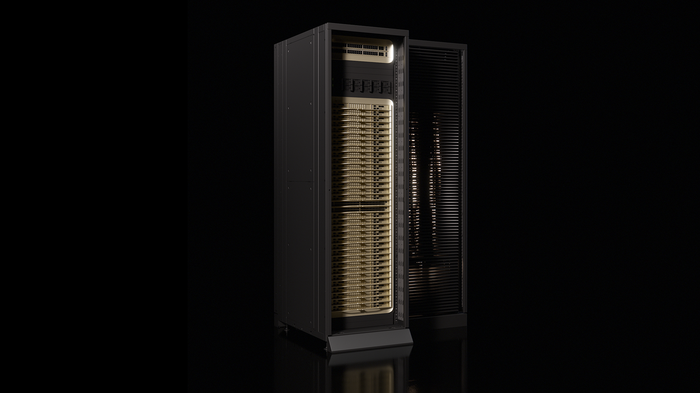
Huang explained the design thinking behind the storage architecture: "Agents have to access memory. KV cache, structured data, unstructured data. It's gonna pound on the storage system really, really hard, which is the reason why we reinvented the storage system."
Microsoft Azure already has the first Vera Rubin rack operational.
Beyond Vera Rubin: Feynman Is Coming
The roadmap doesn't stop at Vera Rubin. NVIDIA previewed two more generations:
Rubin Ultra introduces the Kyber rack system where compute nodes insert vertically into a midplane instead of sliding horizontally. This architecture connects 144 GPUs in one NVLink domain. The Oberon variant scales to NVLink 576 using copper plus optical scale-up.
Feynman is the generation after that, featuring a new GPU, the LP40 next-gen accelerator (Groq's successor chip with NVIDIA's NVFP4 computing structure), the Rosa CPU (named for Rosalind Franklin), BlueField-5, and ConnectX-10 networking.
When asked about the copper versus optical debate, Huang gave the diplomatic answer: "A lot of people have been asking, 'Jensen, is copper going to still be important?' The answer is yes. 'Are you going to scale up optical?' Yes. 'Are you gonna scale out optical?' Yes."
The Groq Bombshell: NVIDIA Acquired the Team and the Tech
This was the surprise nobody saw coming. Huang casually disclosed that NVIDIA "acquired the team that worked on the Groq chips and licensed the technology" — a deal worth $17 billion announced back in December but only now detailed publicly.
The Groq LP30 chip is already in volume production at Samsung and ships in Q3 2026. Each chip packs 500 megabytes of on-chip SRAM and functions as what Huang called "a deterministic data flow processor" with static compilation designed for ultra-low-latency token generation.
The integration strategy is clever: NVIDIA's Dynamo software disaggregates inference workloads between Vera Rubin (handling prefill and attention for high throughput) and Groq chips (handling decode and token generation for low latency). It's a best-of-both-worlds approach.
Huang's deployment recommendation: "If most of your workload is high throughput, I would stick with just 100% Vera Rubin. If a lot of your workload wants to be coding and very high valued engineering token generation, I would add Groq to it. I would add Groq to maybe 25% of my total data center."
The result: 35 times more throughput per megawatt at premium pricing tiers.
Token Economics: Five Tiers from Free to $150 Per Million
One of the most fascinating slides was Huang's framework for AI token pricing, which segments into five tiers:
| Tier | Price per Million Tokens | Use Case |
|---|---|---|
| Free | $0 | High throughput, lower speed |
| Medium | $3 | Standard workloads |
| High | $6 | Faster response times |
| Premium | $45 | Complex reasoning tasks |
| Ultra-Premium | $150 | Coding, high-value engineering |
Huang put it into perspective: "Suppose you were to use 50 million tokens per day as a researcher at $150 per million tokens. As it turns out, as a research team, that's not even a thing." In other words, even at the highest tier, the cost is trivial for high-value work.
The business math: in a one-gigawatt factory distributing 25% of power across each tier, Blackwell generates 5x more revenue than Hopper, Vera Rubin generates 5x more than Blackwell, and adding Groq delivers another 35x improvement at the premium tier.
Performance: 50x in Two Years (Moore's Law Would've Given 1.5x)
Independent analysis from SemiAnalysis validated NVIDIA's claims. Hopper H200 to Grace Blackwell NVLink 72 delivered 35x better performance per watt — but SemiAnalysis measured the actual improvement at 50x.
Huang couldn't resist: "Nobody would have expected 35 times higher. Then SemiAnalysis came out and Dylan Patel had a quote. He accused me of sandbagging. He says, 'Jensen sandbagged. It's actually 50 times.' He's not wrong."
For context: Moore's Law would have delivered roughly 1.5x over the same period. Token generation speed in a one-gigawatt factory went from 2 million to 700 million tokens — a 350x improvement in two years.
DLSS 5: The GPT Moment for Graphics
We covered DLSS 5 in detail here, but the TL;DR: DLSS is evolving from a performance technology into a visual fidelity revolution. DLSS 5 uses neural rendering to infuse real-time game frames with photoreal lighting and materials — essentially bridging the gap between game graphics and Hollywood VFX.
"DLSS 5 is the GPT moment for graphics," Huang said, introducing it as "the most significant breakthrough in computer graphics since real-time ray tracing in 2018."
The technology runs at 4K in real time, has 15+ confirmed games at launch (including Starfield, RE Requiem, Hogwarts Legacy, and AC Shadows), and arrives this fall for RTX 50 Series GPUs.
OpenClaw: "Every Company Needs an OpenClaw Strategy"
In a notable shoutout, Huang spotlighted OpenClaw — the open-source AI agent framework — calling it "the most popular open source project in the history of humanity" that "exceeded what Linux did in 30 years" in just weeks.
"OpenClaw has open sourced the operating system of agentic computers. Now, OpenClaw has made it possible for us to create personal agents," Huang said.
NVIDIA announced enterprise support through NemoClaw, a security stack combining policy enforcement, network guardrails, and privacy routing for deploying OpenClaw agents safely inside corporate networks. They also launched the OpenClaw Playbook — a step-by-step guide to run agents locally on DGX Spark hardware.
Huang's strongest statement: "Every single company in the world today has to have an OpenClaw strategy. Just as we all needed to have a Linux strategy, we all needed to have an HTTP/HTML strategy which started the internet... Every company in the world today needs to have an OpenClaw strategy."
At GTC Park, NVIDIA even set up a "Build-a-Claw" event where attendees could customize and deploy their own AI agents on the spot.
Physical AI: Robotaxis, Robots, and a Walking Snowman
Autonomous Vehicles
NVIDIA announced four new automaker partnerships — BYD, Hyundai, Nissan, and Geely — for its autonomous vehicle platform. Combined with existing partners Mercedes, Toyota, and GM, these manufacturers produce 18 million vehicles annually.
Uber will deploy robotaxis powered by NVIDIA's Drive AV software across 28 cities on four continents by 2028, starting with Los Angeles.
Huang demonstrated the Alpamayo reasoning system with real-time narration: the AI explaining its driving decisions in plain English. "I'm changing lanes to the right to follow my route... There's a double-parked vehicle in my lane. I'm going around it."
He called it "the ChatGPT moment of self-driving cars."
Industrial Robotics
NVIDIA is partnering with ABB, Universal Robots, and KUKA to deploy physical AI models on manufacturing lines, and with T-Mobile to evolve 5G base stations into edge AI platforms for robotics.
The Olaf Moment
Huang capped the keynote with the most unexpected demo: Olaf from Disney's Frozen walked onto stage. Not as a pre-rendered animation — as a physical robot powered by NVIDIA's Isaac GR00T robotics stack, the Newton physics engine, and Omniverse simulation.
"Ladies and gentlemen, Olaf," Huang said, as the character waddled out to stunned reactions.
"Olaf, how are you? I know because I gave you your computer — Jetson," Huang joked. When Olaf asked what that was, Huang replied, "Well, it's in your tummy... and you learned how to walk inside Omniverse."
The closing was peak Jensen: singing robots, a digital Jensen avatar, an animated lobster performing a campfire song, and Olaf sinking back through a trap door. Gaming conference, AI conference, theater performance — GTC 2026 was all three.
NVIDIA Goes to Space
Almost buried in the announcements: NVIDIA is designing AI data centers for orbit. The Vera Rubin architecture (named for the astronomer who discovered dark matter) will eventually power Space-1, bringing accelerated computing from Earth to space.
No timeline was given, but the ambition is clear: NVIDIA isn't just building for data centers. They're building for everywhere computing could exist.
Enterprise Data: 80% Cost Reductions
A quieter but commercially significant set of announcements:
- IBM watsonx.data now uses NVIDIA's cuDF library — Nestlé reduced data mart refresh times by 5x at 83% lower cost across 185 countries
- Dell's AI Data Platform integrates cuDF and cuVS
- Google Cloud BigQuery helped Snapchat reduce computing costs by nearly 80%
The Nemotron Coalition: Six Frontier Model Families
NVIDIA launched the Nemotron Coalition, rallying partners around six open model families:
- Nemotron — Language and reasoning
- Cosmos — World and vision models
- Isaac GR00T — General-purpose robotics
- Alpamayo — Autonomous driving
- BioNeMo — Biology and chemistry
- Earth-2 — Weather and climate
The Takeaway
GTC 2026 was the keynote where NVIDIA stopped hedging. A $1 trillion demand forecast, a surprise acquisition, five tiers of token economics, neural rendering that rewrites how games look, and a Disney robot walking across the stage — all in two hours. The ambition borders on science fiction, and NVIDIA's track record over the past five years says they'll deliver most of it.
The real signal wasn't any single announcement. It was the breadth. NVIDIA is building the infrastructure layer for AI across every domain — gaming, enterprise, autonomous vehicles, robotics, healthcare, climate science. The chip company era is over. This is an infrastructure company for the age of AI, and GTC 2026 was the conference where that became undeniable.
Sources

Founder of GGS Blog and Site Reliability Engineer at Box. I write about gaming, AI in gaming, and game development with a technical lens — 10+ years in software engineering, 20+ years as a gamer. My work focuses on what the tech actually means for players.
Never miss a post
Subscribe to the GGS Blog newsletter for gaming news, tech insights, and AI in the game industry — delivered straight to your inbox.
Free. No spam. Unsubscribe in one click.
Comments
What to Read Next
Continue exploring our coverage of gaming, technology, and AI.
 Technology
Valve's 44% Steam Deck Hike Is the Only Honest Price in Handhelds
Sony added $100-150, Microsoft $100-150, Nintendo $50. Valve added $240 to a 512GB Steam Deck OLED and said nothing. Only one of those companies has no software subsidy to hide the memory bill behind.
 Technology
You Can't Solo Queue Loneliness: The Real State of AI Gaming Companions
AI teammates that fight, loot, and revive are finally shipping — but they only work in the specific games their publishers built them into. Universal companions exist too, but they're spectators. Neither fully solves what a solo player actually needs.
 Technology
Meta's Horizon Worlds VR Whiplash and the Slow Death of the Metaverse Dream
Meta announced it was killing Horizon Worlds in VR, reversed course 48 hours later, and accidentally wrote the eulogy for a $80 billion bet on virtual reality. Here's what went wrong — and what VR actually needs to survive.